A food delivery chatbot replies to customers in messengers while the phone operator is busy: it explains the menu and dish ingredients, checks the delivery zone and time, and collects orders with addresses and phone numbers in the CRM. Complaints, non-standard substitutions, and questions about allergens not covered by your database are handed over to a human along with the chat history. Kyiv-based food delivery and catering service Box Catering generated over 500 leads with a processing time of up to 10 seconds and UAH 500,000 in revenue via the Marichka AI manager.
Let's look at how this works in a small delivery service, where orders come in for both lunch in an hour's time and a corporate event in two days.
Contents
- What the food delivery chatbot handles itself, and what it passes on to the operator
- Friday, 18:40: where the order gets lost while the operator is on the phone
- An hour's lunch and corporate boxes are two different conversations
- What does an order look like without a call via Direct?
- Where the bot stops when it comes to allergens and complaints
- What a café or restaurant needs to prepare for launching a bot
- Frequently asked questions
Section: Instructions and cases
What the food delivery chatbot handles itself, and what it passes on to the operator
The bot handles repetitive conversations where the answer is already in your data: what is on the menu today, how much a set costs, whether you deliver to Poznyaky by seven, or whether it is possible without onions. Decisions that require the kitchen or a manager are left to people.
The Marichka AI manager reads a catalogue from a website or a PDF or Excel file, and automatically pulls updated prices and stock levels. It only answers from this knowledge base. If a customer asks about something not found there, the bot hands the conversation over to a human operator along with the context: what was ordered, where to, and for when. It will not make up an answer.
In practice, the line is drawn here. The bot handles a typical menu order from start to finish. An 80-person banquet with a custom menu is only qualified by it: date, number of guests, budget, format. Then a manager calls.
Friday, 18:40: where the order gets lost while the operator is on the phone
Let's imagine a lunch delivery and catering box service in Kyiv. One female operator, one kitchen, orders come in via phone calls, Instagram, and Telegram.
At 18:40 on Friday, the phone rings non-stop. The operator is dictating the third order in a row to the kitchen, while meanwhile there are six new messages in the direct messages. Someone is asking if there is a vegan set. Someone sent an address without a porch number. The office manager is asking for boxes for Monday for the whole department.
The camera operator will arrive at the director's place at around 19:30. The client who wanted dinner at eight will by that time have already ordered elsewhere. The office manager's request will get lost among the evening orders, and they will only remember it when she has already made arrangements with someone else.
The problem here isn't that people are doing a bad job. Peak delivery hours coincide for all channels at once, and a single operator physically can't keep up. The Marichka AI manager responds in 10 to 30 seconds at any time, so it clears the queue in messengers in parallel with the phone. It's precisely during such hours that a food delivery chatbot is needed the most. Few people are willing to hire a second operator for just two peak hours a week.
An hour's lunch and corporate boxes are two different conversations
Urgent delivery and catering require different questions from the bot. They must not be confused: if, in response to a corporate event enquiry, the bot starts with “where to deliver in an hour”, the client will think they haven't been understood.
| What the bot is clarifying | One-hour delivery | Event catering |
|---|---|---|
| Time | is the kitchen keeping up today, what's the next available slot | date and time, how many days in advance it needs to be ordered |
| Quantity | portions and drinks | number of guests, format (buffet, boxes, banquet) |
| Addresses | delivery area, entrance, floor | event address, is there a kitchen or a room for serving food |
| Who confirms | bot, if the order is standard | post-qualification manager |
For a cafe with a dine-in area, a third scenario is added: table reservation and questions about opening hours. A chatbot for a cafe is usually simpler because there are no addresses or delivery zones. On the other hand, people more often ask about a table for the weekend or the children's menu.
For catering, order automation delivers the greatest value where requests arrive a few days in advance and sit unanswered until Monday. The bot immediately collects the date, number of guests and budget, and during working hours the manager receives a ready-made request and calls back with a proposal already prepared.
What does an order look like without a call via Direct?
Let's go back to Friday. Here is how those same six messages go through the bot while the operator is on the phone.
The customer is asking about the menu and ingredients
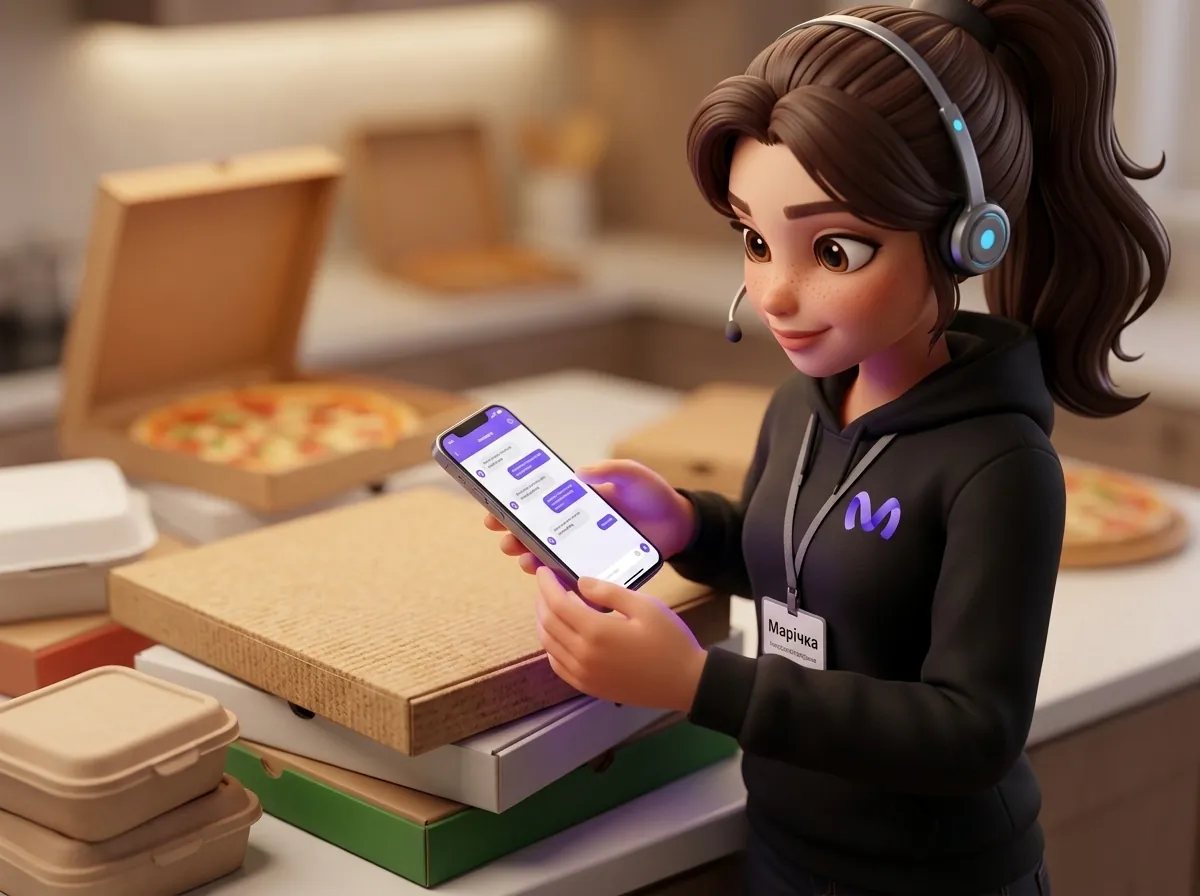
“Is there anything vegan for the evening?” The bot sees two vegan sets in the catalogue, states the prices, and asks how many people it's for. If one set is on the stop list and this is reflected in the catalogue, the bot does not offer it.
The bot is confirming the address and time
Next, the bot collects the details that the female operator usually clarifies after the call: street, building, entrance, floor, telephone, and preferred time. If the address is outside the delivery zone, the bot says so immediately and offers collection, if that is part of your rules. More details on, how a bot leads a buyer from a question to an order, we were writing using the example of an online shop.
The order enters the CRM
When all the data has been gathered, the bot creates an order in the CRM. The operator sees it in the same window as phone calls, complete with the full chat history. All she has to do is confirm it with the kitchen. There is no longer any need to manually copy and paste the address from the chat. Exactly what is transmitted and at which step the integration most often fails is discussed in the article about, what exactly is being passed to the CRM and where it breaks down.
For Box Catering, a Marichka AI client, it worked exactly like this: over 500 leads, each processed in under 10 seconds. If you also have unread messages left over on a Friday evening, test it on your own workflow to see how many of them the bot would have closed on its own.
Where the bot stops when it comes to allergens and complaints
The most sensitive question in food delivery sounds brief: “Are there nuts in here?” The bot gets the answer solely from the knowledge base, so the ingredients of dishes must be in the catalogue.
The law also requires this. According to Article 9 of the Law of Ukraine “On information for consumers regarding food products” (No. 2639-VIII), when selling non-prepacked food products at a distance, information on ingredients causing allergies must be available to the buyer prior to purchase. The State Production and Consumer Service in its clarification of 22 September 2026 reminds that the list covers 14 groups of allergens, in particular milk and nuts. In the photo of the dish in the catalogue, the sauce or filling is not visible, so a customer with an allergy will ask in the chat.
Hence a rule of thumb. If the dish composition is listed in the catalogue, the bot replies and names the allergens. If there is nothing in the catalogue or the customer writes about a severe allergy, the bot transfers the conversation to a human, who can double-check with the kitchen. It must not reassure the customer with guesswork.
It is the same with complaints. “They brought it cold”, “they got the order mixed up”, “the courier was an hour late” – here you need a person who can apologise and decide whether to refund the money. The bot takes such a message, flags it as urgent and passes it on to an operator along with the order number. It should not promise compensation itself, and that is worth spelling out directly in the settings.
What a café or restaurant needs to prepare for launching a bot
Most of the work before launch is non-technical. A food delivery chatbot knows nothing that isn't in your files. A restaurant or delivery bot works only as well as your data is complete. Before the test, gather:
- Menu with prices, portion sizes and ingredients, where allergens are indicated.
- Delivery zones by district with the delivery cost for each.
- Kitchen schedule: until what time are you taking orders for today, from which day is catering available.
- Advance payment and cancellation policies for large orders.
- List of situations where the bot always hands over to a human: complaints, banquets, allergies without data in the catalogue.
The out-of-stock list is a separate matter. A bot for a café or delivery service cannot see your kitchen, and if the kitchen keeps the out-of-stock list on paper, the bot will not know about it. The simplest solution is to update availability where the bot gets its catalogue from: on the website or in a file.
Next, connect the bot to a single channel: the one that receives the most messages during your peak evening. A week of testing will show what questions customers actually ask, what is missing from the knowledge base, and how many orders the bot processes without a human operator. Marichka AI offers a free 7-day trial for this. Launch the test so that it includes your busiest evening: that is what will show how many messages used to wait for an operator.
Ready to connect Marichka to your channel?
Marichka AI will help you automate communication, reply to clients 24/7 and increase sales.
Frequently asked questions
How does a café chatbot differ from a delivery bot?
In a sit-in restaurant, the bot mostly answers questions about the menu, opening hours and table reservation. The delivery bot also collects the address, time and order details, so it needs your delivery zones and kitchen schedule. If you have both a sit-in dining area and delivery, both scenarios work within a single bot with a single knowledge base.
Does the bot know that the dish has run out?
He knows if this information is in the catalogue he is working with. Marichka AI automatically updates prices and stock levels from the website or file, so it is enough for the stop list to end up there. If the kitchen keeps the stop list only on paper, the bot will not find out about it.
How much does a bot for a restaurant or delivery service cost?
It depends on the number of messages. With Marichka AI, the LITE plan costs €49 a month and includes 1,000 messages, and you can try it free for the first 7 days. During the trial week, you will see how many messages actually come in and whether the limit is enough.
Can the operator be kept on the phone, and the bot put in messengers?
Yes, and for small deliveries this is the most common option. The bot responds on Instagram, Telegram, Viber, Facebook, WhatsApp and the website, and the operator takes calls. Complex conversations are handed over by the bot to her along with the entire chat history.
What will the bot reply if a customer writes after the kitchen closes?
What is stated in your rules: the kitchen is closed, but you can place an order for the morning or for a specific date. The bot collects all the details, and the agent confirms the order when she comes on shift.