
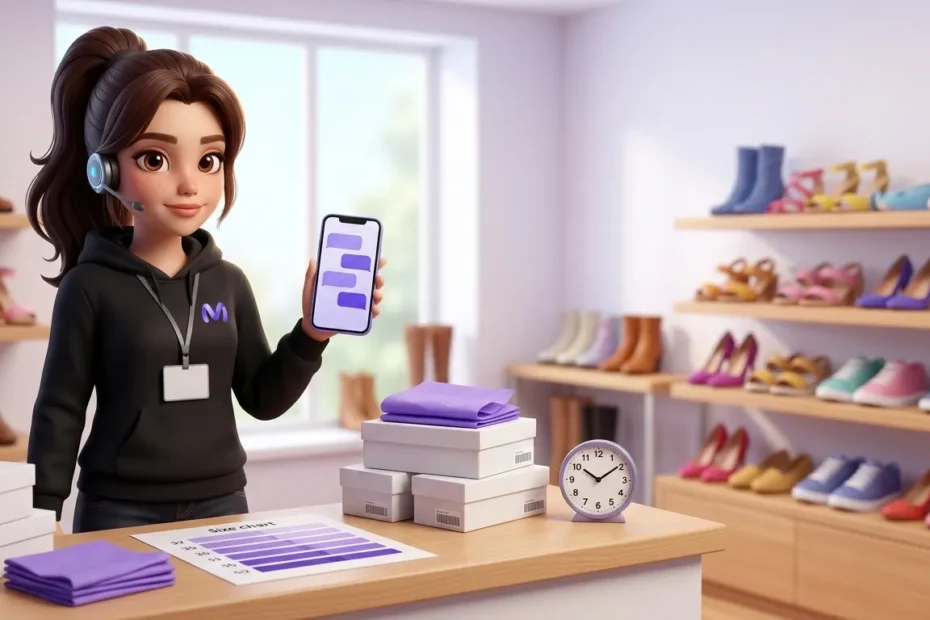
A business chatbot is a program that answers customers in messengers and on a website instead of a manager and takes over repetitive tasks. In a small shop, there are five or six such tasks: stating availability and price, choosing a size, explaining delivery and exchange, placing an order, and following up with those who have gone silent. All of them are broken down below using a single example: an online women's footwear store with an Instagram account and a website, two female managers, and shifts until 19:00.
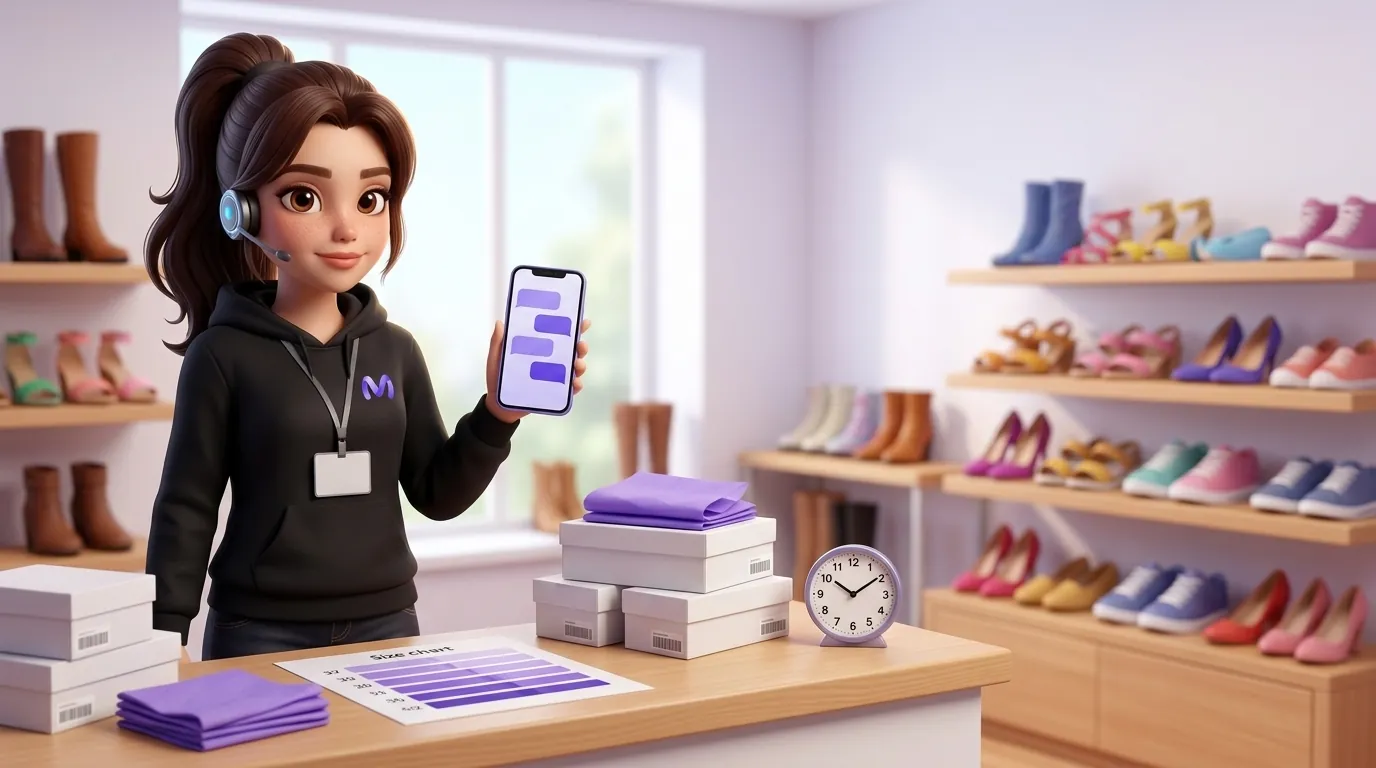
What business tasks does a chatbot solve in a small shop
At 21:30, a female customer writes in Direct: “Do you have these ankle boots in a 38? I have a wide foot, will they fit? And how much is delivery to Dnipro?” The managers are already at home. Three questions in one message, and there is an answer to each of them in your data: stock levels, fit description, carrier terms. It is precisely messages like these that a business chatbot takes care of first.
| Task | Script bot | AI bot |
|---|---|---|
| Availability and price | asking for a product code, showing a row from the table | recognises the photo or model name and checks it against the catalogue |
| Size guide | is sending the size chart | asks for foot length and width, recommends a size |
| Delivery, payment, exchange | buttons with pre-written text | answers the combined question in a single sentence |
| Checkout | collects name and phone number in a form | clarifies the model and size, asks for the courier branch, creates an order in the CRM |
| Reminder | scheduled mailing | write to the one who went silent, with the context of her question |
The first three lines generate the most incoming messages. They are the same every day, and the female manager replies to them from memory. The fourth line brings in the money: an order placed at 21:40 doesn't wait until morning, by which time the female customer has already bought a pair elsewhere. The fifth most often falls out of people's work because in the stream of new dialogues no one goes back to yesterday's.
The bot doesn't have to close all five tasks from the first day. A shop with two female managers will find it enough to start with one or two.
Where to start: the most expensive task
Your own chats will suggest the first task for the bot. Take the last fifty conversations in your direct messages and label each with two tags: the topic of the first message and the time it arrived.
Then it is simple arithmetic. If half of the questions are about availability and sizing and a third come in after closing, start with night-time replies regarding size and availability. If the female managers manage during the day, but orders that female clients did not complete are being lost, make processing and reminders your top priority.
Another useful observation from the same selection. Look at how many dialogues ended with the manager's reply “I'll check and get back to you”. Every such dialogue shows what data is missing from the catalogue. This is a list of what needs to be added to the knowledge base before launching the bot, otherwise it will stumble over the exact same things.
Bot channel rules: Instagram, Telegram, Viber
Each messenger has its own rules for bots, and they directly affect the tasks the bot will be able to perform. This applies most of all to reminders.
In Instagram, the bot works via Meta's official API, and this requires a professional account. Documentation Meta for Developers It states clearly: the app has 24 hours to respond to a user message. Outside this window, a reply is only permitted if marked as being written by a human operator. For the shop, the conclusion is clear: an automated reminder to the female customer who asked about ankle boots and went silent must be sent within 24 hours.
Telegram has two paths. You can set up a separate bot with its own name. You can connect a bot to a regular store account via Telegram Business: according to Telegram's description from 31 March 2024, such a bot processes messages and replies on behalf of the business, and it is up to you to choose which chats it has access to. For example, only new conversations without personal contacts. An important condition: Telegram Business features, including connecting a bot, are only available with a Telegram Premium subscription.
The rules here are stricter. From 5 February 2024, Viber issues new bots via an application and a contract. For Rakuten Viber terms, messages within the 24-hour session following a subscriber's message are not charged. Bot-initiated messages outside the session are paid, and the bot itself incurs a monthly fee of €115. There will be a separate breakdown regarding Viber in more detail. For store tasks, it is enough to remember one thing: proactive messages cost money there.
Hence the rule of thumb for all three channels, which stems from Meta's documentation and Rakuten Viber's terms. The bot must reply and send reminders within the first 24 hours. Anything later falls to a human or incurs a separate charge.
What a business bot should not do
There are tasks where an automated reply does harm. Returns and exchanges after wear, complaints about defects, delivery disputes, requests for a discount above your limit, wholesale orders from another shop. Here, the customer expects a decision, and a decision can only be made by a person with the authority to make it.
Here is how it looks in a shoe shop. A female customer writes: “Received the boots a week ago, the seam on the left one has come apart, what should I do?” The bot does not promise either a replacement or a refund. It asks for a photo of the seam and the order number, writes that a manager will reply by 11:00, and puts the conversation first in the queue. In the morning, the manager sees the photo, the number and the gist of the complaint in a single card and resolves the issue in five minutes.
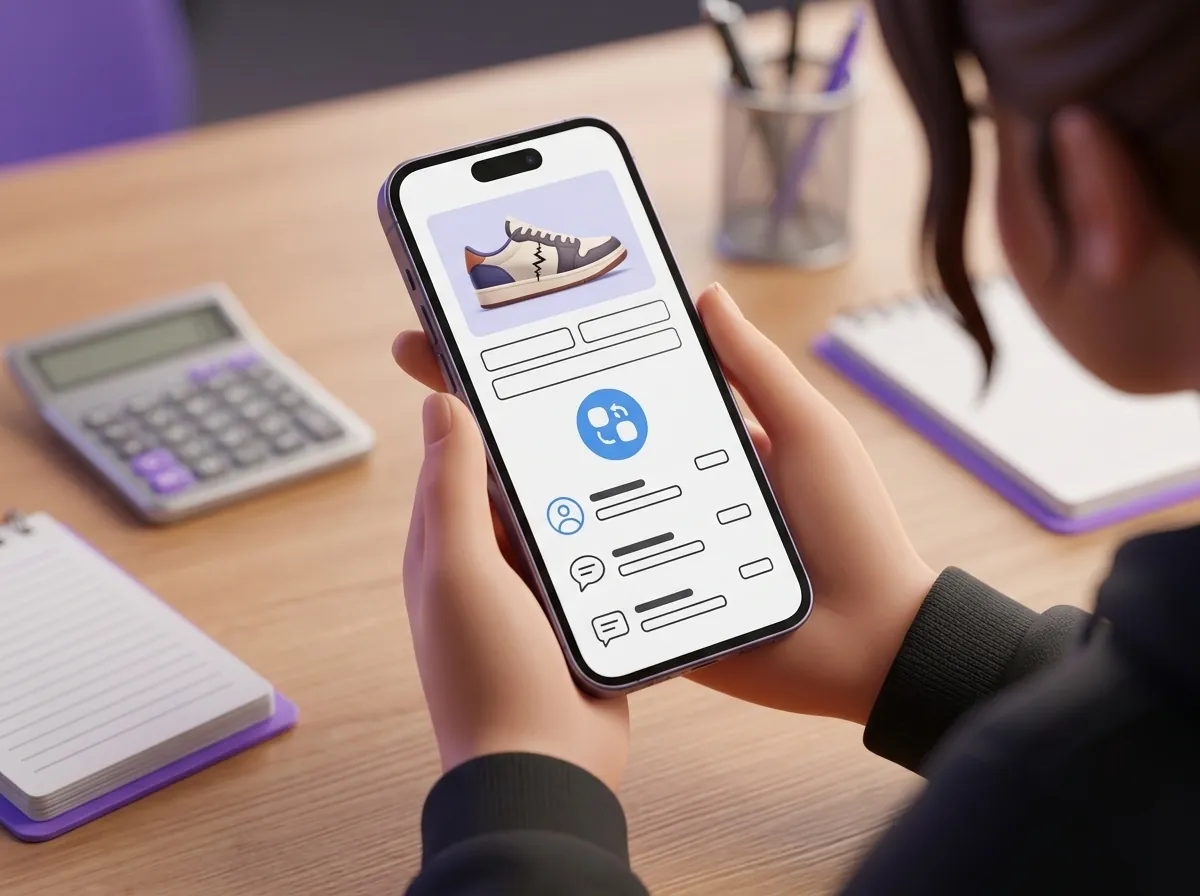
A well-configured business bot recognises such dialogues and passes them on to a manager along with the conversation history so that the customer doesn't have to explain everything a second time. With Marichka AI, a complex question goes to an operator with context, and the bot only takes answers from the knowledge base. Make this a condition for any service you are considering: a bot that makes up an answer about returns costs more than a bot that honestly says “I'll connect a manager now”.
Scripted bot or AI bot tailored to your needs
A button-based bot handles the first row of the table and partially the third. As soon as variables (size, completeness, city, date) appear in the question, the button tree grows and the female client writes “manager”. The difference between a scripted bot, an AI bot and an AI manager is detailed in the article about the difference between a scripted bot, an AI bot and an AI manager.
For a shoe shop, the limit is reached at size matching. If you have a single last and standard sizing, buttons will cope. If models run small, there are wide and narrow lasts, and female customers ask about a specific foot, you need a bot that reads the model description and free text.
The same rule applies when you need a chatbot for a company with a product where questions are not repeated verbatim. The Marichka AI sales manager, for example, compiles a catalogue from website pages or PDF or Excel files, automatically updates prices and stock levels, and replies within 10–30 seconds on Telegram, Instagram, Facebook, Viber, WhatsApp and in the website widget. A single knowledge base for all channels means that the answer about exchanges is the same in Direct and on Viber.
How much does it cost and how long does the launch take
There are three paths. A button bot in a builder is assembled by you yourself for a service subscription, and you spend your own time on the scenario tree. Custom development costs like a separate project and makes sense when a non-standard integration is needed. A ready-made AI manager is sold as a subscription with a message limit: Marichka AI starts from €49 per month, the first 7 days are free, and setup is code-free.
The launch time for a store with several hundred models depends primarily on the state of the catalogue on the website. If the prices, photos and stock levels are already up to date on the website's pages, the bot fetches them via a link and starts responding immediately after the channel is connected. If the catalogue only lives in the manager's head or in an outdated spreadsheet, the main time will go towards gathering this data into a PDF or Excel file; connecting the bot itself takes mere hours. How to compare the subscription cost with the money left in direct messages at night is explained in the breakdown on how to calculate the ROI of an AI sales agent.
Business chatbots pay off where there is a flow of identical questions and night-time conversations. A shop with a dozen messages a week does not need a bot yet: the manager manages on her own.
Tomorrow morning, before your first coffee, open Direct and count how many messages came in overnight and how many of those are about availability and size, and how many are about delivery. That first number is the volume of work for the bot in the first week of the trial.
Setup — under 10 minutes · No commitment · Money-back guarantee
Frequently asked questions
How much does a business chatbot cost?
It depends on the path. A button-based bot in a builder can be put together independently for a service subscription, custom development costs as much as a separate project, and a ready-made AI manager is sold as a subscription with a message limit. At Marichka AI, tariffs start from €49 a month, with the first 7 days free.
Does one need a programmer to connect the bot?
For a script bot in a constructor and for a ready-made AI manager, a programmer is usually not needed: channels are connected via settings, and the catalogue is uploaded using a website link or a file. A programmer will be needed if the bot is written from scratch for your accounting system.
Can a single bot reply in all messengers at once?
Yes, if the service supports multiple channels with a single knowledge base. Then the response regarding the size chart or delivery is the same in Instagram Direct, Telegram, Viber, and the website widget, and a price change updates everywhere simultaneously.
Is it okay to message a female client if she hasn't replied for more than a day?
In Instagram, an automated response is possible within 24 hours of the user's last message, after which a human operator must write. In Viber, messages initiated by the bot outside the 24-hour session are paid. Therefore, reminders should be set within the first 24 hours.