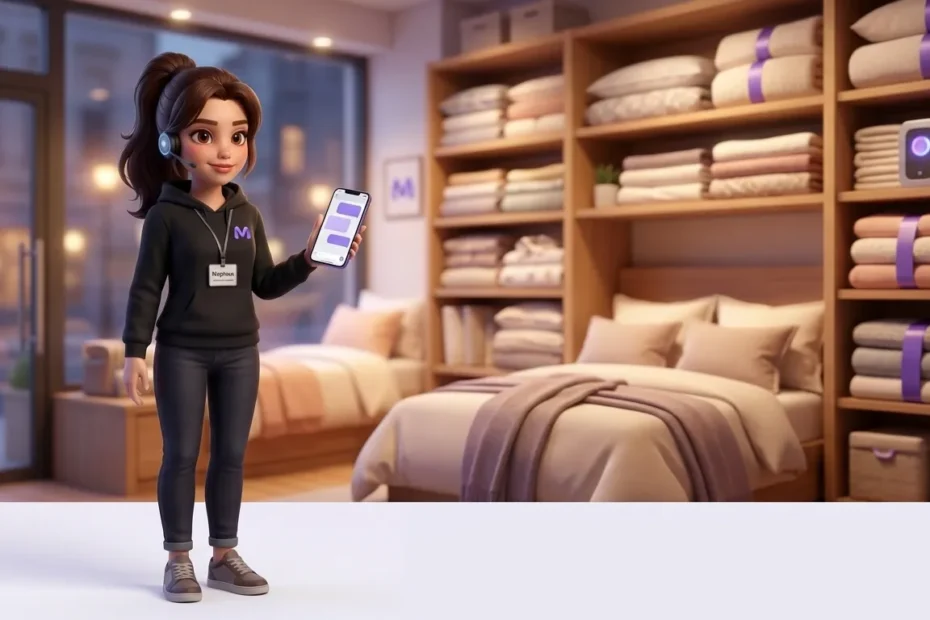
An online store chatbot responds to customers in messengers and on the website instead of a manager: it selects products from the catalogue, states the current price and availability, collects delivery details and creates an order in the CRM. A good bot guides the conversation through to a completed order, and passes complex queries over to a human with the full chat history.
Below we will look at one evening in a small bed linen and throw shop. Website, Instagram, CRM, the owner and a manager who also packs parcels during the day. This shows precisely where orders are getting lost and what the bot needs to know not to lose them.
Contents
- At 21:50, four questions are written to the bed linen shop
- Where orders get lost when a person replies
- How an online store chatbot conducts a dialogue up to the point of purchase
- Where does the bot get data on fabrics and leftovers?
- The order must appear in the CRM while the customer is still in the chat
- The bot always handles returns, complaints and discounts for the customer
- A week of testing on your own questions
- Frequently asked questions
Section: Instructions and cases
At 21:50, four questions are written to the bed linen shop
A female customer saw a grey set on Instagram and writes in direct: “Do you have Euro size in satin? How is satin better than calico? How much is shipping to Lviv? Can you dispatch tomorrow?” Four questions in one message, and each requires separate information.
The size and fabric are described in the product card. The availability of the grey euro size specifically depends on stock levels, which change daily. For delivery, your rules are needed: carrier tariffs, the minimum amount for free shipping, and the cut-off time for same-day dispatch. And the owner has explained the fabric comparison hundreds of times, and this text is not written down anywhere.
For textiles this is a regular evening. A person is looking for a specific size for their mattress and until they get an answer, they put nothing in the basket. Buyers of footwear or children's clothing behave the same way: the more variants a product has, the more questions there are before checkout. A chatbot for an online store with such an assortment must answer all four, otherwise the female customer will go looking elsewhere.
Where orders get lost when a person replies
During the day, the manager replies between packing parcels and calling the courier. Messages from Direct and the website chat arrive in different windows, with some waiting an hour. In the evening, the owner replies from her phone, if she has time.
It is precisely such long questions, like the one in the scenario above, that get lost most often. To answer, one has to open the inventory spreadsheet, check the stock level, and recall the delivery tariff. The person puts it off “until morning”, while the female buyer in the meantime writes to two other shops with a similar set.
Hiring an evening manager is an obvious answer, but not a simple one. In a Horoshop study published on 19 March 2026, online store owners specifically complained that they were failing to find qualified personnel, which was hindering scaling. The same survey showed that 88 % of entrepreneurs are already using AI in their work. However, the majority of them, 53 %, are at a basic level: simple tools like ChatGPT for texts. AI has become a daily part of processes for 35 %. It is in this gap that communication with customers lies: the texts for product cards are already written by AI, but questions in direct messages in the evening still go unanswered.
How an online store chatbot conducts a dialogue up to the point of purchase
Let's go back to 21:50. AI sales manager Marichka AI receives a message and, according to the service description, responds within 10–30 seconds at any time of day. Here is how the conversation goes if the bot is connected to the catalogue and CRM:
- The bot checks the stock level and replies that the grey satin Euro size is available, states the price from the website and the fabric composition.
- To the question about sateen and calico, it gives a brief explanation from the knowledge base that the owner once wrote herself: density, sheen, and how it behaves after washing.
- It states the delivery cost to Lviv according to your rules and writes that an order placed before a certain hour will go out tomorrow.
- Offers pillowcases of a different size as a set, if they are available in the catalogue, and asks if they are needed.
- Asks for contact and shipping details, confirms the payment method and creates an order in the CRM.
The female customer received answers to all four questions within a few minutes and completed the purchase without waiting for the morning. At 9:00, the manager opens the CRM and sees a ready-made order there with the branch address.
A shop chatbot that works on buttons and trigger words usually stops at the third step: it has no script for “how much is delivery to Lviv”. AI for an online store understands a free-form question, but the answer only makes sense when your up-to-date catalogue is close at hand.
Where does the bot get data on fabrics and leftovers?
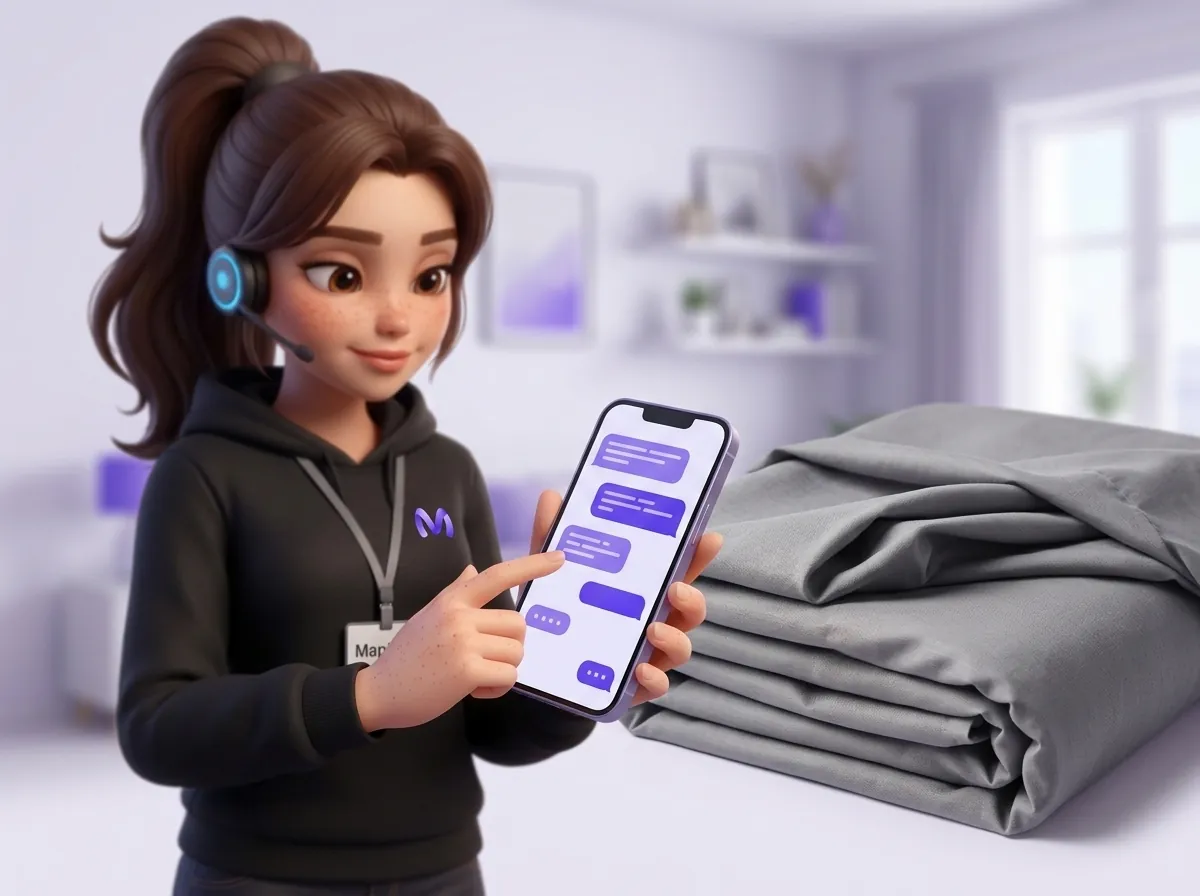
The bot responds as accurately as the data it has been given. Marichka AI only answers using the shop's knowledge base. If the required data is not there, the bot hands the question over to a human. Therefore, before launching, it is worth looking at your catalogue through the eyes of a customer.
| Buyer's question | What a bot needs | Where does this usually go |
|---|---|---|
| Are there euros in grey? | Product variants and stock levels | Website or stock list |
| How much is it? | Current price, promotions | Website |
| Why is sateen better than calico? | Explanation about fabrics | Owner's head, old replies in direct |
| How much is delivery and when will you dispatch it? | Tariffs, departure times | Delivery and payment page“ |
| Will it fit a 160×200 mattress? | Dimensions of the sheet and duvet cover | Product page with a size chart |
The bot takes the first two lines from the website itself: Marichka AI scans product pages and automatically updates prices and stock levels. Delivery rates and dispatch rules can be uploaded as a PDF or Excel file. The most work is with the third line: answers that exist only in the owner's head will have to be written down once.
If the size chart is only in the photo, the bot will not read it as text. Move it to the product description. This will also help customers on the website. It is convenient to start with the twenty most frequent questions from your Direct: you can already see from them whether the AI for the online shop is coping with your assortment.
The order must appear in the CRM while the customer is still in the chat
A dialogue that ended with the words “yes, place the order” is not yet an order. Until someone transfers the data to the CRM, the parcel won't be sent. Therefore, a chatbot for an online store must create the order card itself: product and quantity, buyer's contacts, and delivery.
Then in the morning the manager works with the CRM just like with regular website orders: confirms, packs, dispatches. There is no need to separately reread the night-time chat. When a conversation goes beyond the knowledge base, for example a female customer asks to make a set for a non-standard mattress, the AI manager hands her over to an operator along with all the context.
Instagram has its own connection rules and Meta limitations, which we have broken down in the article about, how to connect a bot to Instagram Direct.
The bot always handles returns, complaints and discounts for the customer
There are conversations in which a human has to make the decision. The buyer received a kit, the colour is not the one in the photo, and they want to return it. The Law of Ukraine “On Consumer Protection” gives the right to cancel a distance contract within 14 days (Part 4 of Article 13 of Law No. 1023-XII) The bot can explain general refund conditions if you put them in the knowledge base. However, negotiating an exchange, delivery compensation or a discount for the inconvenience is up to a manager.
It is the same with complaints about quality and requests to “make it cheaper”. You will have to honour the discount that the bot promised without any rules. Therefore, you should explicitly state in the settings that the bot must immediately pass such issues on to a human.
It is helpful to divide conversations into two groups before launching. The first goes everything for which there is an unambiguous answer in the catalogue and store rules: availability, price, size, delivery, payment. The second group requires a decision, such as returns, defects, individual terms or wholesale prices. The first you give to the bot, the second you leave for yourself.
A week of testing on your own questions
Testing AI for an online store on a developer's demo catalogue is of little use. You need to know whether the bot can handle your satin, calico and 160×200 sizes.
Connecting to Marichka AI is code-free, following an 8-step video guide, and the first 7 days are free. Day one: give the bot your website address and a file with delivery rates, and add answers to the questions from the third row of the table. Next, ask twenty real questions from Direct over the last month, including the most awkward ones. See where the bot answered inaccurately and fix the data in the catalogue itself: the phrasing usually adjusts accordingly. For the last few days, let real buyers in during the evening hours and in the morning compare the orders in the CRM with the chat history.
In a week it will become clear what the chatbot is capable of for an online store with your specific product range: how many evening conversations ended in an order without your involvement and how many questions the bot honestly handed over to a human. If you currently have unread messages sitting in your direct messages after 21:00, start the test with those very messages.
Ready to connect Marichka to your channel?
Marichka AI will help you automate communication, reply to clients 24/7 and increase sales.
Frequently asked questions
How much does an AI bot for an online store cost?
At Marichka AI, the lowest LITE tariff costs €49 per month and includes 1,000 messages and two managers, with an additional thousand messages costing €25. You can work for free for the first 7 days to calculate how many messages your particular shop receives.
Can the bot state an incorrect price or an item that is out of stock?
AI manager Marichka AI responds exclusively from the store's knowledge base: the website catalogue, uploaded PDF or Excel files. Prices and stock levels are updated automatically, so an error is only possible if the incorrect data is in the catalogue itself. If the answer is not in the base, the bot hands the conversation over to a manager.
What happens if the buyer wants to speak to a person?
The bot transfers the chat to an agent along with the entire conversation history and what the customer has already selected. The manager does not need to ask for the size or address again, they simply continue from where the conversation left off.