
A follow-up (from the English “follow-up”, meaning a subsequent step) is a repeat message sent to a customer after an initial conversation to help them make a purchase. In an Instagram-based shop, a follow-up is most commonly needed for those who asked for the price and then went quiet. Below is a breakdown of when to write it, what exactly to say, and how many times.
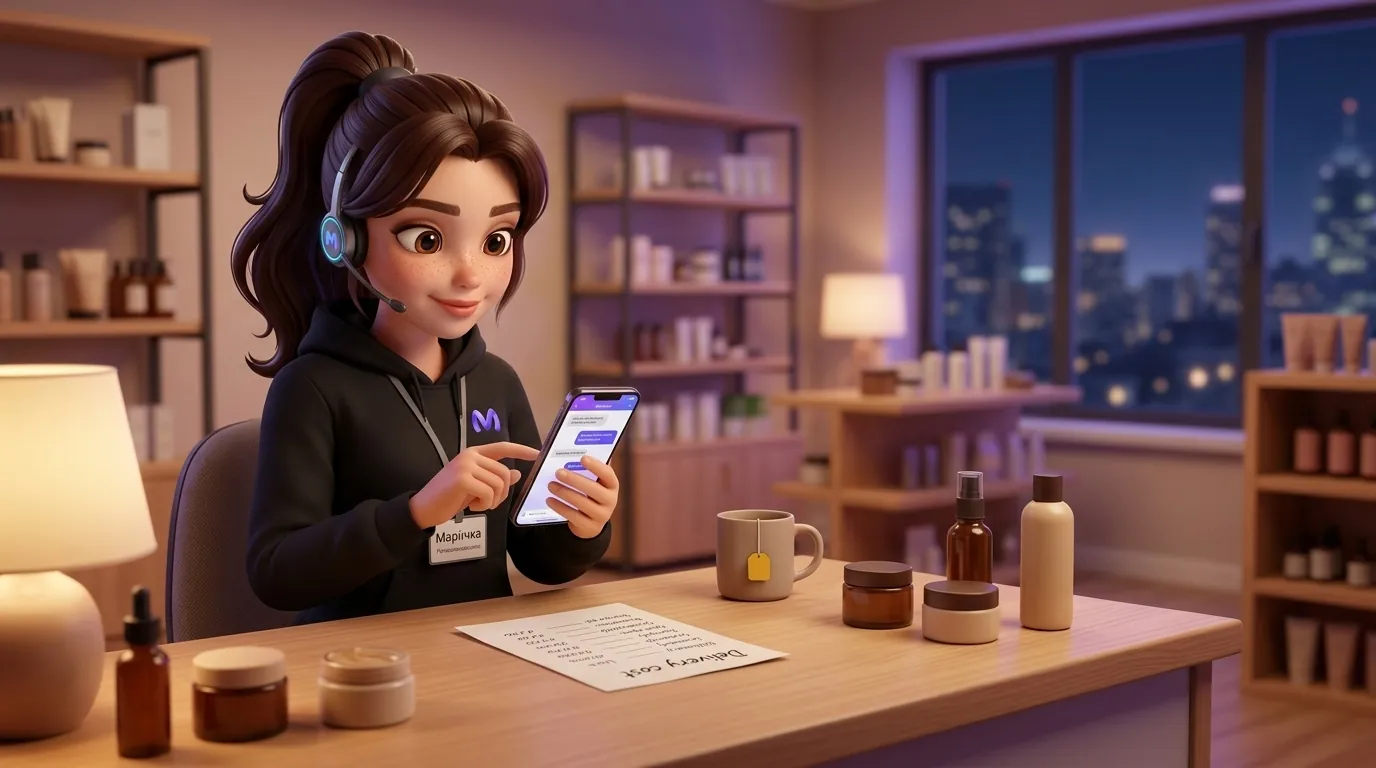
An example we will return to in every chapter. A skincare cosmetics shop, main sales go through Direct, there is a website with a catalogue, one female manager works until 19:00. At 22:10, Oksana writes: “How much is the vitamin C serum and how much is delivery to Zhytomyr?” In the morning, the manager replies with the price and delivery cost. Oksana reads the message. And writes nothing more.
Follow-up in sales: what it looks like in practice
A follow-up in sales means any contact after the initial conversation that moves the deal forward. For a small shop using instant messengers, this mostly involves three situations, and each calls for its own message.
The first situation, the most frequent one: silence after the price. The female client received a reply and didn't respond. The second arises after an order: the parcel has arrived, and it is worth asking whether the product suited her, or reminding her about a repeat purchase when the jar runs out. The third relates to the website: a person put an item in the basket and left, but you have their contact details because they already wrote in Direct.
Oksana from our example belongs to the first group. She has the highest chance of converting because the interest is still fresh: she came by herself looking for a specific product and a specific delivery city. A follow-up is simply an attempt to understand what stopped her between the price and the order, and to remove that obstacle.
If you were looking for what a follow-up is after a webinar on B2B sales, the term sounds different there: a post-meeting email, a call a week later, a series of touchpoints over the course of a month. In retail, the sales cycle is shorter. A female customer makes a decision about a serum costing a few hundred hryvnias in the course of an evening, which is why you should get back to her on the very same day or the next one.
Why clients go quiet after the price
Silence in the DMs doesn't necessarily mean a rejection. Sometimes a person has run into a minor obstacle, put off the decision and forgotten.
Most data on such barriers has been collected for online shop baskets. According to data Baymard Institute, the average documented cart abandonment rate is 70.22 %: this is an average of 50 studies, with the page updated in September 2025. It also lists the reasons. The most common one, cited by 40 % of respondents, relates to extra charges on top of the product price, primarily for delivery. This is followed by slow delivery (20 %) and the requirement to create an account (18 %). A further 42 % of US shoppers abandoned their carts because they were “just browsing”.
These figures were gathered for website baskets. It is not worth transferring the percentages directly to direct mail, although the logic transfers well. Oksana asked about delivery in the same message as the price. It is entirely possible that she was put off by the delivery charge itself, and a reminder that says nothing about this will go unnoticed.
When to post: The 24 hours that messengers give
In messengers, you are not the only one who determines the timing of a follow-up message. Platforms restrict what a business can send to a customer who hasn't replied for a long time.
In WhatsApp the rule is stated outright. According to Meta's documentation for the WhatsApp Business Platform, when a user messages or calls a business, a 24-hour service window starts, and each new message they send restarts the timer. While the window is open, you can send normal messages. After it closes, only pre-approved templates remain available. Each template is assigned a category (marketing, utility or authentication) and undergoes automated review upon creation.
In Instagram the logic is similar: according to Meta documentation, an automated response is possible within 24 hours of the client's last message. Details about other channels, including why proactive messages in Viber are paid, are gathered in the analysis messenger rules for shop bots.
For Oksana, this implies a specific deadline. She wrote at 22:10, and the manager replied at 09:30. The window is counted from Oksana's last message, so she can be messaged in free text in the direct chat until 22:10 the following evening. If the manager only remembers her the following week, a template will remain in WhatsApp, but the automated reply in Instagram will no longer be available.
What to write to avoid sounding like “Still thinking about it?”
The messages “Still thinking?” or “Just following up” are perceived by the female client as pressure. They add nothing to the conversation, so it is easy to ignore them a second time. An effective follow-up always brings new information or removes a specific obstacle.
| Situation | Weak message | Work message |
|---|---|---|
| Silence after price and delivery | “Oksana, are you still thinking about it?” | “Oksana, delivery to Zhytomyr arrives at the branch the next day. If it's more convenient, we can send it to the parcel locker near your home.” |
| Doubts about the product | “Are you taking the serum?” | “This serum is suitable for sensitive skin, but for the first week it is better to apply it every other day. There is a 5 ml sample, I can add it to the order” |
| Abandoned basket on the website | “You left an item in your basket” | “I see that the SPF cream is left in your basket. There are two left in stock, shall I put one aside for you until this evening?” |
| After delivery | “How do you find your purchase?” | “You've had the serum for a week now. If your skin feels tight, apply it first, before your moisturiser.” |
Please note the third line. The phrase about the remaining stock only works if it is true: the bot or manager must see the actual inventory. Faked urgency destroys trust after the very first check.
Every row of the table is structured in the same way. First a name or specific product, then a fact the female client did not know yet, then a simple next step with a single yes or no answer.
How many times to remind and when to stop
For a retail store in messengers, a sensible limit is two follow-ups per conversation. The first within 24 hours, addressing a likely objection. The second a few days later, if the channel allows, offering a different benefit: a sample, an alternative product, or a restock date.
After two messages without a reply, it is better to stop. A third “reminder” in a row without an answer will easily be perceived by the client as spam and she will unsubscribe. The dialogue does not disappear with this: mark it in the CRM, and if Oksana writes in a month, the manager will see what was discussed.
There are signals after which reminders are not sent at all. A female customer explicitly said that she had bought elsewhere. She asked not to write. Or the conversation turned into a complaint: a person with the authority to make a decision is needed here; an automated reminder will only cause irritation.
Remind manually or via an AI manager
The manager in our example knows all these rules. The problem lies elsewhere: in the morning there are thirty new messages in the direct messages, and yesterday's Oksana ends up at the bottom of the list. By 10:10 pm the next day, no one will remember her because new chats always look more urgent.
Automation removes precisely this memory issue. According to Marichka AI's description, an AI sales manager replies in direct messages within 10–30 seconds at any time of day, so Oksana would have received the price and delivery details at 22:10 while she was still browsing. It pulls answers exclusively from the shop's knowledge base and passes complex questions on to the human manager along with the chat history. How the agent handles the entire journey from the first message to the order, including following up with a customer who went quiet, is shown in the breakdown how an AI agent conducts a dialogue from the first message to the order.
For the automated reminder to sound like a line from the table above, the bot needs the same data as the female manager. Delivery terms by city, availability of testers, current stock levels, application tips for the products. If this is not in the catalogue or knowledge base, the bot will write a polite but empty “do you have any questions left?”. Therefore, before launching, go through a dozen of yesterday's dialogues and write down the answers the female manager gave off the top of her head. This is the list that needs to be added to the database.
Ручне нагадування має сенс, коли діалогів мало і кожен коштує дорого: оптове замовлення, подарунковий набір під конкретну дату, постійна клієнтка. Там особисте повідомлення від людини доречніше. Масові однотипні нагадування “ціна плюс доставка” людині краще не доручати: вона їх просто не встигне.
Сьогодні ввечері відкрийте директ і знайдіть діалоги, де остання репліка ваша, а клієнтка писала менше доби тому. Для кожного, де питали ціну або доставку, напишіть одне повідомлення з новим фактом за зразком з таблиці, поки 24-годинне вікно ще відкрите.
Frequently asked questions
What is a follow-up in simple terms?
Це повторне повідомлення клієнту після першої розмови, яке допомагає йому зробити наступний крок: оформити замовлення, обрати розмір, забрати посилку. Добрий фоллоу-ап відповідає на питання, яке клієнт не встиг поставити, і не зводиться до “ну що, берете?”.
What is a follow-up and how is it correctly spelled in Ukrainian?
Follow up з англійської означає “продовження, подальший крок”. В українських текстах зустрічаються форми “фоллоу-ап” і “фолоу-ап”; усталеного правопису словники поки не дають, тому в межах одного тексту варто тримати одну форму.
How long should I wait to follow up with a client who hasn't replied?
In messengers, the first reminder should be sent within twenty-four hours of the client's last message. In Instagram and WhatsApp, it is precisely 24 hours that allow you to write in free text, after which platform restrictions apply.
Can follow-ups be sent automatically?
Yes, if the bot can see the conversation history and writes within the channel's rules. The automatic follow-up should be based on the customer's specific question, while complex situations, such as a complaint or a request for a discount, should be handed over to a human.