AI for business in a small company starts with a single task that can be measured. First, the owner tries out the chat on their own texts and spreadsheets, then agrees on rules with the team, and only after that puts artificial intelligence on customer correspondence. It is usually the third step that brings in orders, but without the first two it more often than not leads to disappointment.
Let us take a small online board game shop. Sales are made through Instagram and the website, orders are managed in a CRM, and the team consists of three people. The owner handles purchasing and social media, a female manager replies to customers, and another person packs parcels. Customers ask which game would suit four adults, whether 8-year-old children will understand the rules, and whether there is an expansion for a box already bought. We will walk through the entire journey using this shop as an example.
Contents
- What are companies in Ukraine already doing with AI for business?
- Three levels at which artificial intelligence operates in a small company
- Tasks that the owner assigns to the chat group themselves during the first week
- Customer data in a free chat is a bad idea
- Where AI saves minutes, and where it returns orders
- The customer writes at 23:00, and the manager is already asleep
- What to gather before launching AI for sales
- The team is taught on the course, but the rules are written themselves
- How to tell in a month whether AI for business has paid off
- Frequently asked questions
Section: AI for business
What are companies in Ukraine already doing with AI for business?
Ukrainian companies are already trying out artificial intelligence on a mass scale. According to a Top Lead survey supported by the Ministry of Digital Transformation (published in January 2025, over 200 companies of various sectors and sizes), 93 % of those surveyed already use AI. Around 64 % use it in marketing and sales, while 62 % have noticed a positive impact on productivity and metrics.
This figure should be read with a caveat. The sample contains just over 200 companies, and how many of those were small businesses is not stated in the Ministry of Digital Transformation's publication. Therefore, it says little about a three-person shop.
Another observation from the same survey is more useful. The main motive cited by companies is the automation of routine tasks. For a board game shop owner, the routine is quite specific: repetitive questions in Direct, descriptions of new boxes, transferring addresses to a CRM.
Three levels at which artificial intelligence operates in a small company
Artificial intelligence for small business is conveniently broken down into three levels. The difference between them is who sees the model's output.
At the first level, the AI helps the owner. It writes a draft game description, translates the rules from English, and condenses reviews into a short list of complaints. Only you see the mistake here and correct it before publication.
At the second level, a team works with AI. A manager prepares responses using templates, and the packing staff member checks stock levels. This raises the question of rules: what can be pasted into the chat, and who checks the texts before sending.
The third level is the client level. The model answers the buyer itself on Instagram or on the website, and its mistake is seen by a person who was just about to buy. That is precisely why this level requires a knowledge base and a person on standby.
Tasks that the owner assigns to the chat group themselves during the first week
Start with what takes up the most of your time at the keyboard. In a gaming store, that is almost always texts: a new product page, a post about a new arrival, a reply to a detailed review.
Give the chat real input data. The request “write a game description” will produce generalities, so add the title, number of players, age, game duration and three sentences of your own about who will like it. Compare the result immediately with what you would have written yourselves. If you edit more than half the text, the task is not yet suitable for AI.
The second candidate is spreadsheets. The model will break down quarterly sales exports into groups, suggest which games are bought together, and propose bundles. Still, double-check the figures in the CRM: the model is adept at confidently making calculation errors.
In a week you will have a list of two or three tasks where AI genuinely saves time. Next, you can think about shop-wide processes, and this is where an analysis of will help, in what order to automate shop processes.
Customer data in a free chat is a bad idea
A typical first-month mistake is copying a chat conversation with a customer, along with their phone number and address, into a public chat. It is a convenient way to draft a reply, but the data has already gone to a third-party service.
The terms of such services for personal and business tariffs differ. In August 2025, Anthropic updated the rules for free and paid personal Claude plans: if the user has allowed, conversations go towards training new models and are stored for five years. Without permission, there is a 30-day retention period. Corporate tariffs and API access are not subject to these rules. Similar settings exist in other popular chats, so check them in your account before pasting work data there.
For the shop, the rule is simple. Public chats receive texts about products, generalised reviews without names and tables without personal data. Telephone numbers, addresses and order numbers remain in the CRM and in services with which you have a contract and clear data processing.
Where AI saves minutes, and where it returns orders
Not all tasks pay off equally. AI in business can easily be taken up with a dozen minor applications that each save five minutes, never getting around to the ones that impact sales. The table will help prioritise for a game shop.
| Task | Who is winning | How to measure | The main risk |
|---|---|---|---|
| Descriptions of new games | owner | minutes per card | identical text on all cards |
| Review analysis | owner, female manager | how many claims were found and closed | missed single complaints |
| Response templates | female manager | time of first response in the afternoon | the template does not fit the question |
| Customer replies in the evening and at night | customer, shop | orders from chats outside of working hours | fabricated availability or price |
| Transferring orders to CRM | female manager | errors in addresses for the week | duplicate order |
The first three lines relate to team time. The final two are about money: a buyer who is replied to at 23:00 places an order immediately. Without a reply until the morning, they have often already bought from another shop.
The customer writes at 23:00, and the manager is already asleep
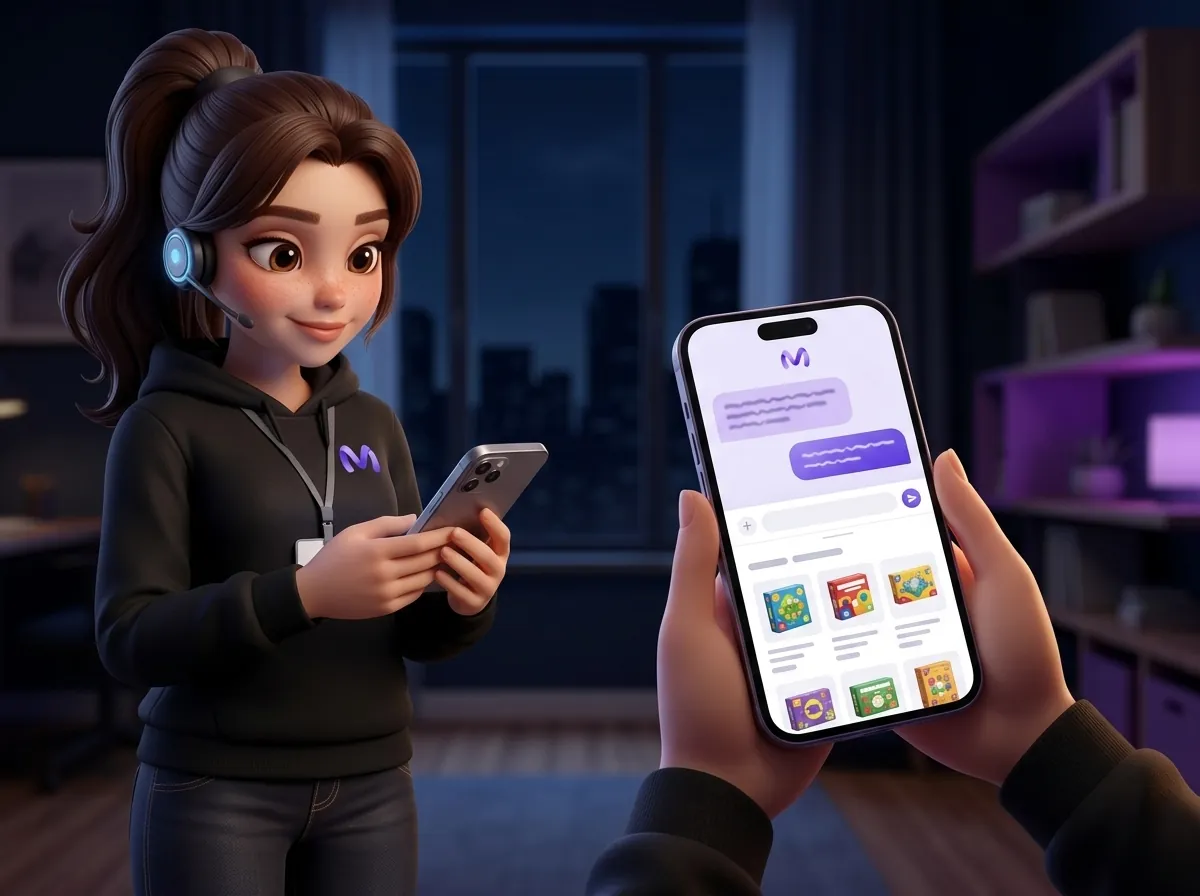
The client tier is an AI manager connected to your channels. It reads the catalogue, answers customer questions and creates orders while the team is resting.
In the games shop, an evening looks like this. At 23:10, a mother writes in the direct messages: “Looking for something for my son’s birthday, he’s 9, there will be four other friends, budget up to a thousand hryvnias.” A standard button bot would offer a menu with categories. The Marichka AI sales manager selects two or three games from the catalogue based on age, number of players and price, confirms the delivery address and creates an order in the CRM.
The response arrives in 10–30 seconds at any hour. Marichka AI draws product knowledge from a database: from website scans, PDF or Excel files, and automatically updated prices and stock levels. She replies solely using this database, so she will not promise a box that is out of stock. If a question goes beyond her scope (a complaint, a wholesale order for a board game cafe), the conversation is handed over to a manager along with the entire history.
Such systems are called AI agents, and about that, how an AI agent conducts a conversation with a customer prior to ordering, we wrote separately. The easiest way to check if this suits your shop is to use your own evening chats from the past week.
What to gather before launching AI for sales
AI for business works only as well as the quality of the data you give it. Before connecting, you should prepare five things:
- Catalogue with current prices and stock levels: link to the website or a file that is updated.
- Delivery and payment terms, exchange and return policy in a single text, without any contradictions between the website and the profile bio.
- 20–30 questions that customers ask most frequently, along with your best answers.
- List of topics that the bot always forwards to a human: complaints, wholesale, non-standard discounts.
- Access to the CRM or at least an understanding of how orders from the chat will get there.
For the game shop, the third point is the most valuable. The questions “how many players” and “what age” are repeated here every day, and the manager's answer is usually better than the manufacturer's description.
The team is taught on the course, but the rules are written themselves
Training doesn't have to be invented from scratch. In autumn 2025, the Ministry of Economy, together with Google Ukraine and the company Edera, launched a free practical course called “AI for Business”. It lasted 5 weeks, consisted of video lessons of up to 15 minutes, live sessions and workshops, and required no technical knowledge. Participants received a certificate, and the 100 most active ones got into a mentorship programme. Check the course page to see if a new intake is open.
The course provides the big picture. Your team will have to write your own rules, and they fit onto a single page. What can be posted in a public chat and what cannot. Who checks texts before publication. Who updates the AI manager's knowledge base when a new batch of games arrives.
Artificial intelligence in a three-person business relies on one responsible person. In our shop, that's a female manager: once a week she reviews the chats the bot has handed over to her and writes responses into the database.
How to tell in a month whether AI for business has paid off
Before starting, note down three figures: how many messages arrive after 20:00 during the week, how many of those receive a reply before morning, and how many orders the shop processes from chats. After a month, compare the same weeks.
If night-time messages have started closing with orders, the customer tier is paying for itself. To estimate costs, the junior Marichka AI tariff costs €49 a month for 1,000 messages, and the first 7 days are free of charge. If, however, there are no changes, look at the dialogues handed over to the manager: most often, the database is missing answers to a few common questions.
AI for small business doesn’t need a six-month strategy. For a week, the owner tests the chat on their own texts, then the team gets a page of rules, and after that, the AI manager takes over the evening messages from Instagram. Start by counting: open your direct messages and see how many buyers wrote to you after closing over the past week and never got a reply.
Ready to connect Marichka to your channel?
Marichka AI will help you automate communication, reply to clients 24/7 and increase sales.
Frequently asked questions
How much does it cost to start using AI in a small business?
The first step can be taken for free: the owner tries out the public chat using their own texts and spreadsheets. Money comes into play when the AI starts responding to customers: AI manager services operate on a monthly subscription, for instance, at Marichka AI the junior tariff costs €49 a month for 1,000 messages, and there is a 7-day trial before payment.
Can customers be replied to using the free ChatGPT or Claude?
It is not worth copying customer correspondence there. In personal pricing plans, conversations may be used for model training and stored for years, if permitted in the settings. For client dialogues, you need a service connected to your channels, with its own knowledge base and the transfer of complex issues to a manager.
Does the team need a dedicated AI specialist?
Usually, no for a small company. It is enough for one person to be responsible for the knowledge base: updating the catalogue, delivery terms and FAQs. Setting up the AI manager in the dashboard does not require a programmer, and it passes complex cases on to a real person.
Which channel should I start with if customers are messaging both on Instagram and the website?
Starting from where the most messages are left unanswered in the evening and at the weekend. For most small shops selling via social media, that is Instagram Direct. The website and messengers can be connected later to the same assistant with the same knowledge base.