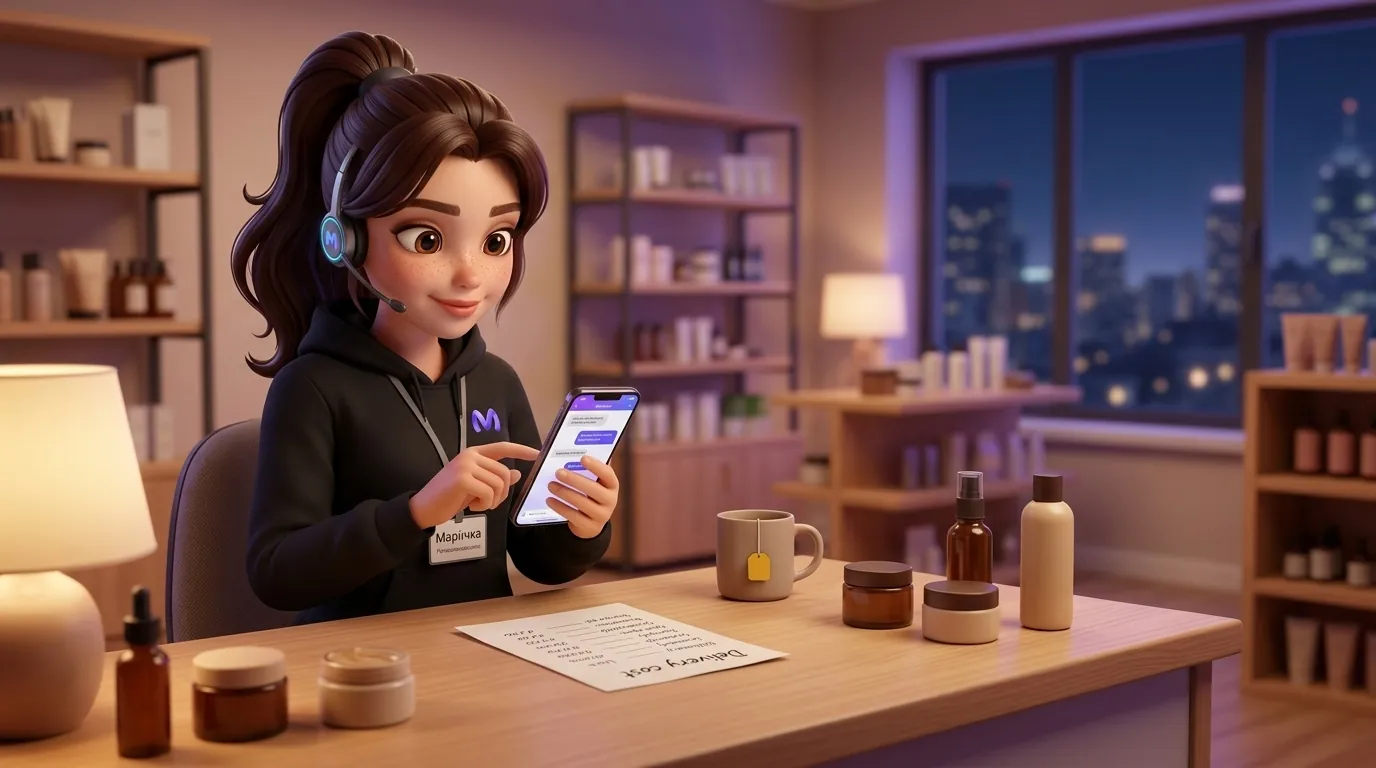
Business process automation is the handing over to a program of those actions that people repeat every day according to identical rules: answering a typical question, entering an order into a CRM, reminding a customer about a basket. A small shop does not need to automate everything at once. Start with a single process where there are the most identical messages, and in a month you will see whether it works.
Let's imagine a skincare cosmetics shop that sells via Instagram and a website. There are two female managers, a CRM is already in place, and several dozen messages come in a day. The owner Googles how to organise this and comes across texts about automating enterprise business processes: ERP, document management, projects lasting six months. For a team of three, this is overkill. Below is the sequence that suits precisely such a shop.
Contents
- What makes up a day in the life of a small shop’s automation system
- Four signs of a process that can be delegated to a bot
- First stage - identical questions in direct messages
- Sales automation converts correspondence into orders in the CRM
- Second phase – reminding silent customers
- What to leave to people, even when AI automation is already working
- How to check if automation has paid for itself in a month
- Frequently asked questions
Section: AI for business
What makes up a day in the life of a small shop’s automation system
Look at a manager's routine day, and you will see that most of her actions are repetitive. A customer writes in Direct: “Is this cream suitable for oily skin?” The manager opens the website, looks for the ingredients, and copies the answer. The next one asks about delivery to Uzhhorod. The third wants to know if the 50 ml size is in stock.
Next is the processing. The name, telephone number, address and post office branch number are transferred manually from the chat to the CRM. In the evening, the female manager goes through the chats again and writes to those who asked for the price and disappeared.
Only some of these steps require human thought. The rest are searching and copying. It is precisely these links that should be considered first when you are planning business process automation. The loudest topics from meetings, such as a new inventory accounting system, can wait.
A useful one-day exercise: ask your female managers to put a tick next to every message they reply to with a template or by copying from the website. In the evening, count the ticks. This figure will become your starting point and will come in handy in a month's time when you compare the result. At the same time, categorise the ticks by topic: availability, price, composition, delivery, payment. The topic with the longest column will be the prime candidate for a bot.
Four signs of a process that can be delegated to a bot
Before plugging anything in, check the process against four criteria. If at least three match, it is ready for automation.
- Repeats daily, dozens of times, and looks almost identical every time.
- The answer can be found in a single source: on the website, in the catalogue, in the price list, or in the delivery terms.
- A mistake doesn't cost much and is easy to fix: a manager can correct an inaccurate delivery response, but an incorrect refund cannot be undone.
- Delay harms sales. If a customer waits for a reply until the morning, they buy elsewhere.
For a cosmetics shop, questions about ingredients, price, availability, and delivery meet all four criteria. Product returns due to an allergic reaction do not meet the second and third criteria, so we leave those to a human. More details on, what tasks does a chatbot handle in a small shop, we looked at separately.
First stage - identical questions in direct messages
First, give the bot answers to typical customer questions. This is where there are the most repetitions, and it is precisely here that night-time and weekend messages go unanswered for the longest time.
European business is moving in the same direction. According to Eurostat (December 2025), in 2025 20 % of EU enterprises with 10 or more employees used AI technologies, whereas a year earlier this figure was 13,5 %. The most common application is written text analysis, as cited by 11,8 % of companies. For a shop, this amounts to breaking down customer messages: understanding what they are asking and finding the answer.
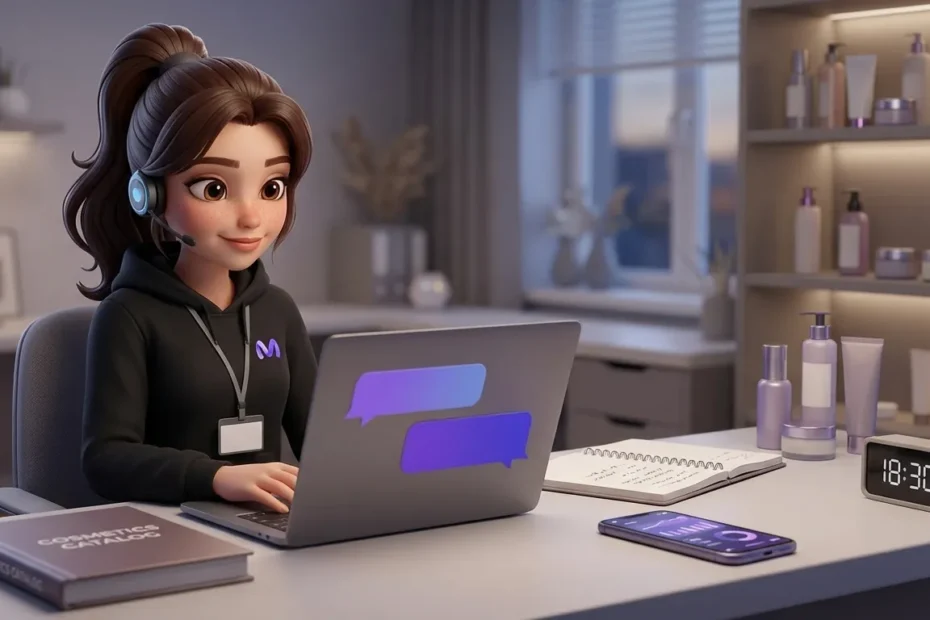
A scripted bot with buttons quickly hits a wall here. A female client writes in her own words, with mistakes, and asks two questions in a single message. The Marichka AI sales manager reads a catalogue from the website or a PDF or Excel file, pulls in updated prices and stock levels, and replies within 10 to 30 seconds at any hour of the day. It takes its answers solely from your knowledge base, so it won't make up a cream's ingredients if they aren't there.
What to prepare for the launch: a current catalogue, delivery and payment terms, answers to the 15–20 most frequently asked questions that the female managers already write every day. This list is usually already sitting in notes or response templates.
Sales automation converts correspondence into orders in the CRM
The second link is the checkout. When the female client is ready to buy, the bot collects her name, phone number and delivery address and creates an order in the CRM. All the female manager has to do is check the card and pass it on to the warehouse.
Surveys clearly show how much time is eaten up by manual work related to sales. The sixth Salesforce State of Sales report (July 2024, involving 5,500 sales professionals across 27 countries) revealed that salespeople spend 70 % of their working time on tasks that are not selling, such as administrative work, data entry, and preparation. In a shop with two female managers, this proportion is also tangible: every order from Direct needs to be transferred manually, the branch number checked, and a typo in the surname corrected.
Sales automation at this stage removes manual transcription. Data enters the CRM exactly as the customer wrote it, and all correspondence remains linked to the order. If there is an issue with the address, the account manager sees the context and does not have to ask from scratch.
Check one thing before you start: can your CRM accept orders from an external service. Ask CRM support about this or check the integrations section in its settings: it is better to know the answer before the trial than to find out on the third day.
Second phase – reminding silent customers
When responses and orders are already automated, add a reminder. A female client asked for the price of a serum, received a reply and vanished. The female manager could have written to her in the evening, but in the flow of new chats she forgets about it.
The bot remembers every such dialogue and returns to it after a set time with a short message: the item is still available, here is the link to checkout. The tone and frequency should be thought through, because too persistent a reminder is annoying. About, how to arrange a follow-up so that it isn't annoying, there is a separate analysis with message examples.
What to leave to people, even when AI automation is already working
AI automation handles the repetitive stuff well, but every store has situations where a human has to make the decision. These should be identified in advance and programmed into the bot: on these topics, it hands the conversation over to a manager.
Complaints and returns
A client is writing to say that irritation has appeared after using the cream. Empathy is needed here, along with a decision on a refund and, potentially, a consultation regarding the ingredients. The bot can collect photos, the order number and the purchase date, but a human must provide the response.
Non-standard and large orders
A beauty salon wants to take 40 treatment units and is asking for a discount. Wholesale terms, a gift set for a specific event, an agreement on deferred payment – these are negotiations, and the result depends on who is conducting them.
With Marichka AI, a complex question is forwarded to an agent along with the conversation history. The manager opens the dialogue and immediately sees what the female client has already asked, which products she looked at, and what she was told. How many topics to leave for humans depends on your product range. To start with, two or three will be enough, and the list can be expanded once you see real dialogues.
How to check if automation has paid for itself in a month
Before launching, record the starting figures, otherwise in a month there will be nothing to compare with. Four metrics that the shop can pull itself from the CRM and messengers are enough.
| Indicator | How to count | Where to get |
|---|---|---|
| Time to first response | average time from client message to response, separately by day and night | chat history |
| Unanswered dialogues | how many messages were left without a reaction for over an hour during the week | Instagram, Telegram, website widget |
| Order from chat | how many orders have been created from chats per month | CRM, filter by source |
| Time for female managers to do routine tasks | how many hours a day are spent on routine responses and data migration | self-esteem a week before and after |
The first metric will change the fastest, because the bot responds straight away. Orders from chats grow more slowly, because they are also affected by seasonality and advertising campaigns. Therefore, look at all four together and compare identical periods.
For a small shop, business process automation starts with one daily pain point. A six-month big project can be postponed. Take the answers to typical questions in direct messages, prepare a catalogue and an FAQ list, and launch a bot for a week. Seven days of trial will be enough to see how many dialogues it closed on its own and how many it handed over to the female managers.
Ready to connect Marichka to your channel?
Marichka AI will help you automate communication, reply to clients 24/7 and increase sales.
Frequently asked questions
What is business process automation in simple terms?
This is when repetitive work that people perform following identical rules is taken over by a program: answering standard questions, transferring data between systems, reminding customers. For a small shop, people usually start with customer correspondence, because that is where there are the most identical actions every day.
Does one need a programmer to automate sales in messengers?
For a typical shop, mostly no. AI manager services connect to Instagram, Telegram or a website via settings in the dashboard, and take product knowledge from the website or a catalogue file. A programmer might be needed if your CRM does not have a ready-made connection to the service.
Will a bot replace a sales manager?
In a small shop, a bot takes care of identical questions and order transfers, while the manager is left to handle complaints, returns, and non-standard deals. The workload usually shifts: the same person manages to process more dialogues where their input is genuinely needed.