AI in small business sales is changing four things. Customers receive an initial response within seconds, at any time of day. Customers often arrive having already received advice from a chatbot. Product selection and order placement take place directly within the chat itself. And the manager spends their time on conversations where a human touch is genuinely needed, rather than answering dozens of repetitive questions about price and delivery.
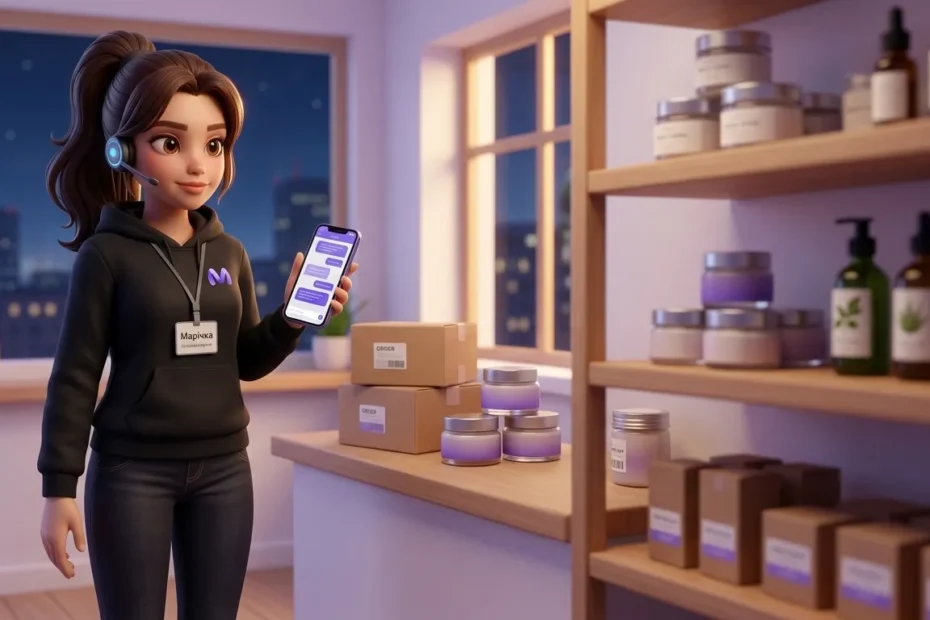
Let’s look at an example. Imagine a shop selling natural cosmetics: sales via Instagram and the website, orders managed in the CRM, with the owner and one manager, Irina, who works from 9 am to 6 pm. At 11.10 pm, a customer messages via Direct: she wants to know if a vitamin C serum is suitable for sensitive skin and whether the parcel will arrive by Saturday. Next, we’ll go through each stage of this conversation and see what artificial intelligence changes and what remains the same.
Contents
- The first reply won’t wait until morning
- The customer arrives having already received advice from the chatbot
- Product selection and ordering take place via messaging
- The manager looks after those who need someone
- Where AI in sales goes wrong and how to minimise this
- How to see a change in your figures in two weeks’ time
- Frequently asked questions
Section: AI for business
The first reply won’t wait until morning
The most noticeable change concerns timing. Without AI, a customer who sends a message at 23:10 will receive a reply at 9:20 the following day, once Iryna has worked through the overnight queue. According to the product description on the website, Marichka AI’s AI sales manager responds within 10–30 seconds, even at night and on Sundays.
The channel doesn’t matter. The same assistant can reply via Instagram Direct, Telegram, Viber, Facebook Messenger, WhatsApp and the widget on the website. This is handy for a cosmetics shop: some customers message via Direct after seeing Stories, whilst others open a chat on the website from a product page; previously, both streams of enquiries were handled by a single person.
A manager’s morning looks different too. Previously, Iryna would start her day with 15–20 unread messages, half of which were “how much does it cost” and “is it in stock”. Now these questions have already been answered; some of the conversations have resulted in orders, and there are just a few conversations left in the queue marked “need a person”.
You can see exactly how many night-time messages your shop receives in your Instagram statistics or CRM history. Take a look at the past month to see at what time customers who didn’t end up buying got in touch. If these conversations tend to cluster in the evenings and at weekends, the bot will close these time slots first.
A quick reply does not in itself guarantee a sale. It merely eliminates the pause during which the customer might have time to go to another shop selling a similar serum. After that, it all depends on how informative the reply is.
The customer arrives having already received advice from the chatbot
The second change is driven by the buyer, and it is easy to overlook. According to a survey by Kantar Ukraine (1,000 respondents aged 18–55, September 2025), 23 % Ukrainians have already tried using AI whilst shopping, a further 36 % want to give it a go. 13 % ask AI for advice, 12 % use personalised recommendations, and 10 % have chatted with chatbots from shops or marketplaces.
Kantar also found out exactly what people want from such an assistant. 44 % of those surveyed expect AI to show them the cheapest options or discounts, whilst 35 % expect it to explain the differences between products. A customer looking to buy a serum might already have asked ChatGPT what the difference is between vitamin C and niacinamide, and come to you with a specific query.
This is why new questions are popping up in Direct. Instead of “what would you recommend for my face?”, a customer writes “what is the concentration of vitamin C in your serum and what is its base?”. A manager who answers from memory struggles with such questions. An assistant who can see the full product details provides an accurate answer, and if the information isn’t available, they honestly say they’ll check and get back to her.
Salespeople are noticing the same thing. In HubSpot’s State of Sales 2025 report (based on a survey of over 1,000 sales professionals), 74 % of those surveyed said that AI makes it easier for buyers to research products.
For a small shop, this leads to a practical conclusion. The standard greeting “Good evening, how can I help you?” no longer works, because the customer knows exactly what she wants. She needs a precise answer about a specific item: stock availability, quantity, price and delivery time. This is precisely where artificial intelligence in sales, linked to your catalogue, is more useful than a generic chatbot that knows nothing about your stock levels.
Product selection and ordering take place via messaging
Previously, conversations on Direct would end with the phrase “Please leave your number and a manager will call you back”. Now, the entire process can be completed directly within the chat.
Let’s go back to the late-night shopper. The AI manager asks for her skin type and budget, checks the catalogue to see if the serum is available in the required size, and suggests an alternative if it isn’t. It then asks for the city and delivery method, quotes the price and creates an order in the CRM. In the morning, Irina sees the order already processed, complete with the full conversation history.
Technically, this is based on what is known as agent-based AI: the model generates text whilst simultaneously carrying out actions within your systems. If you’d like to find out more, we have a separate article on the difference between an AI agent and a standard bot. All the shop owner needs to know is that this assistant reads the catalogue, remembers the entire dialogue and guides a typical conversation through to an order without any human intervention.
Knowledge of the product range is crucial here. Marichka AI retrieves data from website scans or from PDF or Excel files and updates prices and stock levels automatically. Without this, even the smartest model will promise a customer a product that is no longer in stock.
A separate point about assessment. In a cosmetics shop, this boils down to a few specific details: skin type, the issue at hand, budget, and whether it’s a gift. In a clinic or estate agency, there are more questions, but the logic is the same. The assistant gathers the answers during the conversation, and the customer receives a complete picture rather than just a blunt “I’m interested in the price”.
What gets entered into the CRM is also changing. When a manager manually transfers an order from Direct, some details get lost: she might forget to note that it’s a gift, or mix up the branch number. An order created by an assistant contains what the customer wrote in the chat, and the chat history itself remains nearby in case anything needs checking.
The manager looks after those who need someone
What business owners fear most is that the use of AI in sales will lead to a sales manager being made redundant. In small businesses, however, the opposite is usually the case: the range of tasks changes.
Who actually needs Irina? A customer returning a cream because of an allergy. A customer who wants to put together a large gift set with bespoke packaging and a card. A wholesale nail salon enquiring about a discount on 50 items. Someone who’s unsure and just wants to speak to a real person.
This final point is also borne out by the figures. According to the same Kantar survey, only 22 % of shoppers fully trust AI recommendations, 56 % trust them partially, and roughly the same number as the former do not trust them at all. That is why a properly configured assistant does not pretend to be human and does not drag out the conversation unnecessarily. When a question goes beyond the scope of the knowledge base, Marichka AI passes the dialogue on to an operator along with the context, so the customer does not have to explain everything all over again.
What does this mean for Iryna in practice? Less copying of prices from a spreadsheet into Direct, and less manual entry of addresses into the CRM. More time for returning customers, reviews, putting together gift sets and having conversations that encourage people to come back.
How the process works in practice. A customer writes that her skin became red after using the last cream and asks if she can return an opened jar. The assistant doesn’t argue or make up return policies. He replies that the matter has been forwarded to the manager and queues the conversation with a brief note: who the customer is, what she ordered, and what her complaint is. Irina opens the conversation and immediately sees the crux of the matter, without having to scroll back through twenty messages.
It’s worth deciding in advance that there are certain things you’ll never leave to automation. For a cosmetics shop, these usually include complaints, returns, medical queries such as “is this suitable for pregnant women?”, and any discounts not listed in the price list.
Where AI in sales goes wrong and how to minimise this
There are two types of errors: the assistant either invents things that aren’t there, or provides out-of-date information. Both problems can be resolved through the settings. It is pointless to expect the “smart model” to figure it out on its own.
Rule number one: answers must come solely from your knowledge base. If there is no information about the composition in the catalogue, the assistant must say “I’ll check with the manager” and hand the conversation over. Marichka AI works exactly like this, responding only based on the uploaded data.
The second rule concerns the timeliness of data. Post-promotion prices, quantities sold, and changes to delivery times ahead of the festive season – all of this must be entered into the database before a customer enquires about it. Automatic updates from the website resolve most issues, but it is best to check seasonal delivery conditions manually once a week.
Rule three: read the dialogues every day during the first week. Ten minutes in the evening will be enough to spot the questions the assistant answers uncertainly and to add the correct answers to the database. If you skip this step, those same incorrect answers will be repeated for weeks on end, and you’ll only find out about them when complaints come in.
Another risk is less obvious: tone. If your shop communicates in a warm, informal manner, but your assistant writes in dry, bureaucratic phrases, your regular customers will notice. Set the tone and provide a few examples of responses in the settings from day one.
How to see a change in your figures in two weeks’ time
The best way to check any promises is through your own conversations. Connect the assistant to the channel with the most unanswered messages, and in two weeks’ time compare these figures with those from the previous period:
- Average time to first reply: for messages sent after 6.00 pm.
- The proportion of enquiries received outside working hours that were answered and resulted in an order.
- How many conversations has the assistant converted into orders in the CRM without human intervention?.
- How many calls have been forwarded to the manager, and for what reasons?.
- Complaints or strange replies found whilst browsing the site every day.
If you’d like to compare the chat assistant with other options, there’s a separate review of that, What types of AI tools for sales are there?. For a shop that sells via messaging apps, it makes sense to start by talking to the customer, as that’s where the most costly losses occur.
The main way AI is transforming sales is through the division of labour. Routine conversations are handled automatically at night and at weekends without human intervention, whilst the manager focuses on those customers who need her attention. The easiest way to check whether this will work for your shop is to try it out for yourself: Marichka AI offers a 7-day free trial, which is enough time to connect your Instagram account, upload your catalogue and see how many night-time messages turn into orders.
Ready to connect Marichka to your channel?
Marichka AI will help you automate communication, reply to clients 24/7 and increase sales.
Frequently asked questions
Will AI replace sales managers?
In a small shop, AI handles repetitive conversations: prices, stock availability, delivery and processing standard orders. Returns, complaints, non-standard enquiries and decisions on discounts remain the responsibility of a human. The manager receives fewer repetitive messages and more conversations where the outcome depends on her.
What is agent-based AI in simple terms?
This is the term used for systems that not only respond with text but also carry out actions: checking stock levels in the catalogue, creating orders in the CRM, and transferring the conversation to a human. In sales, this acts as an assistant that independently guides a typical conversation towards an order, within the rules you have set for it.
Do shoppers trust advice from artificial intelligence?
To some extent. According to a Kantar Ukraine survey (September 2025), 22 % of shoppers fully trust AI recommendations, 56 % trust them to some extent, whilst approximately 22 % do not trust them. Therefore, responses should be based on your product catalogue, and in cases of doubt, it is best to hand the conversation over to a human.
Where should a small shop start when implementing AI in its sales operations?
Of all the channels where messages are most likely to go unanswered, Instagram Direct tops the list. Put together a guide containing up-to-date prices, answers to 20–30 frequently asked questions, and guidelines for handing a conversation over to a member of staff. For two weeks, check the conversations daily and count how many of them resulted in an order.