A sales script is a five-part plan for a conversation with a customer: a greeting tailored to their enquiry, questions about their needs, a proposal based on their responses, prepared responses to common objections, and an agreement on the next step. It guides the sales manager on how to steer the conversation, whilst allowing them to choose their own words.
Imagine an online shop selling professional cosmetics for manicurists. The owner, Marta, sells via Instagram and her website. Diana, a manager, has been working at the shop for three years and knows exactly what questions to ask a manicurist looking for a base coat for gel polish. A month ago, Marta took on a second manager, Andriy. He responds politely, but his conversations often end with the words “thank you, I’ll think about it”. The script is still fresh in Diana’s mind. Below, we’ll set it out on paper, element by element.
Contents
- A sales script outlines the flow of the conversation; there’s no need to learn the text by heart
- A greeting that makes the customer realise their enquiry has been remembered
- How many questions should you ask to ensure the conversation doesn’t turn into an interrogation?
- A proposal offering two options based on what the client said
- Prepared responses to three objections you hear every week
- The next step, with a date, brings each conversation to a close
- Sales script example: one template for a call and a direct message
- Review of the script based on records and correspondence once a month
- Frequently asked questions
Section: AI for business
A sales script outlines the flow of the conversation; there’s no need to learn the text by heart
When you search for “what are sales scripts”, you often come across pages of pre-written text with lines for every possible situation. For a small shop dealing with incoming enquiries, this is unnecessary. A customer who has messaged you directly about a nail base isn’t expecting a company presentation. She just needs an answer to her question and some advice.
The sales script consists of five stages, and at each one the sales manager knows the objective. At the first stage, the manager must show that they have listened to the customer’s enquiry. At the second stage, they must find out what the product is for and what the customer has already tried. Next, the manager suggests one or two options, addresses any concerns and agrees on the next steps following the conversation. Between these stages, the manager speaks in their own words.
For Marta, this script solves a specific problem. Andriy doesn’t have to spend three months listening to Diana to understand how she sells. He sees the same five steps, and Marta can check any of his conversations: were there any questions, was an offer made, and has an agreement been reached?
A greeting that makes the customer realise their enquiry has been remembered
The first part of the script has one aim: the customer must be able to work out within a few seconds who is writing to them or calling them, and why. The name, the shop’s name and the reason for the contact. The reason is linked to an action the customer has taken themselves: they’ve submitted an enquiry, asked about a product or added it to their basket.
On the call, Andriy says something like this: “Good afternoon, this is Andriy from the beauty supplies shop for professionals. You’ve placed an order for a gel polish base coat. I’ve got a few questions so I can give you the right advice – would now be a convenient time?” The last question here acts as a request for permission. A nail technician, in between clients, might reply, “Please ring me back at three,” and that’s also a successful outcome.
In a direct message, the greeting is shorter. You can omit the manager’s name, but you shouldn’t leave out the reference to the enquiry. A reply such as “Good afternoon! ”Yes, we have the product in stock. Could you tell me which device you’re looking for it for?“ immediately moves on to the next point. A generic ”How can I help?’ in response to a specific question forces the customer to repeat what she has already written.
How many questions should you ask to ensure the conversation doesn’t turn into an interrogation?
The question is the most important part of the script, and it is the part that is most often overlooked. A new manager is afraid of keeping the customer waiting and quotes the price straight away. An experienced manager first finds out who the customer is and what they need it for.
Recordings of real conversations show just how many questions are enough. Gong Labs, a division of the company that analyses sales call recordings, analysed 519,000 initial calls with customers. According to the data Gong Labs research (Chris Orlob, updated in March 2026), the best results are associated with 11–14 questions per call. Top-performing salespeople spread their questions throughout the conversation, whilst average performers asked them all in quick succession at the start, making the conversation sound like a questionnaire.
Another study by Gong Labs, based on 326,000 calls lasting 10 minutes each (Dan Morgese, August 2025), provides two further benchmarks. The optimal ratio is 43 per cent of the time spent speaking by the salesperson and 57 per cent by the customer, whilst on average across all calls, salespeople spoke for 60 per cent of the time. In lost deals, salespeople asked around 20 questions per call; in successful ones, 15–16. In other words, asking more questions is only beneficial up to a certain point.
This data has been gathered from lengthy B2B conversations, and it is not advisable to apply these figures directly to a sales call about a gel polish range. The principle remains the same: a few questions scattered throughout the conversation, with the customer doing most of the talking. Drawing on her experience, Diana has compiled the following list for Marta’s shop:
- What type of work is this product intended for: coating, reinforcement, or build-up?
- What platform is the designer currently using, and what does she find unsatisfactory about it?
- How many clients per week – in other words, how quickly a bottle is used up.
- Is the brand important, or can an alternative be offered?
- Where and how quickly do you need the delivery?
You don’t need to set all five in a row. The first two are played at the start; the rest come in when the manager moves on to the options.
A proposal offering two options based on what the client said
The third element brings the answers to the questions together into a proposal. There’s a simple rule here: propose exactly what the client has described in their own words. If the nail technician said, “The base coat starts to peel off on the third day for clients with thin nails”, the proposal begins like this: “For thin nails, we have a base coat with greater elasticity; nail technicians choose it specifically to prevent peeling.”.
Two options give the client a choice without overwhelming them. The first is best suited to the task, whilst the second is cheaper or offers a larger volume for those with a large client base. It’s worth quoting the price together with delivery and the timeframe: a stylist who’s calculating the costs will ask anyway how much it will be “all in”.
At this stage, Andriy would usually list everything in the catalogue. A long list doesn’t help with making a choice: the customer takes a step back, thinking, “I’ll have a look some more”.
Prepared responses to three objections you hear every week
The Fourth Element does not attempt to anticipate every objection. In a small shop, there aren’t many objections, and they tend to be repetitive. For Martha, these are “it’s expensive, I’ve seen it cheaper”, “I’ll buy it somewhere else for now” and “what if it doesn’t work?”. For each of these, the script provides a follow-up question and a fact the sales assistant can refer to: exchange policy, product composition, and reviews from crafters.
We discussed the techniques for answering questions in detail in the article about, How to respond to “that’s expensive” and “I’ll think about it”, with examples. A script need only consist of three or four lines: a statement, a question to establish the reason, and the actual answer. The manager does not read out longer scripts during a conversation.
The next step, with a date, brings each conversation to a close
The fifth element is often left out of conversations that “went well”. The client said thank you, the manager said goodbye, and nobody knows what happens next. A week later, the deal is still in the CRM with the status “considering”.
The next step is a specific action with a time frame: place an order now, send a payment link, call back on Thursday after 6.00 pm, or send photos of the shades via Direct by this evening. Marta gave Andriy a closing line for the end of the conversation: “Let’s agree on how to proceed.” After that, he suggests one of the options and notes the agreement in the customer’s file.
If a customer isn’t ready to buy, the next step is to get back in touch with a specific reason. “I’ll get back to you on Monday when the new shade arrives” sounds different to “let me know if you need anything”.
Sales script example: one template for a call and a direct message
Ready-made sales scripts are handy to have as a template, but you’ll need to adapt every line to suit your own needs. Below is the framework that Marta put together for her shop. The left-hand column is the same for any niche; the other two need to be filled in with your own words.
| Element | On the phone | In the direct message |
|---|---|---|
| Greetings and occasion | “Good afternoon, this is Andriy from the beauty supplies shop for professionals. You’ve submitted an enquiry about the database. Is now a good time?” | “Good afternoon! Yes, we have the parts in stock. Which model are you looking for?” |
| Question | The equipment currently in use, what isn’t working well, and how many clients | One question in the message, followed by the reply |
| Proposal | Two options, as described by the customer; price includes delivery | Two products with photos, prices and delivery times |
| Objections | Clarify the reason; provide factual information (exchange, composition, reviews) | The same, plus a photo or a review from the craftsperson |
| The next step | Order now or call on a specific day | Please include a link to the payment or specify a date for the arrangement |
In messaging, the script is condensed, but no elements are lost. The difference in pace: on a call, questions and answers come thick and fast within a minute; in direct messaging, the conversation drags on for hours, and every message must end with a question or a call to action. A message without a question will simply be read and closed by the client.
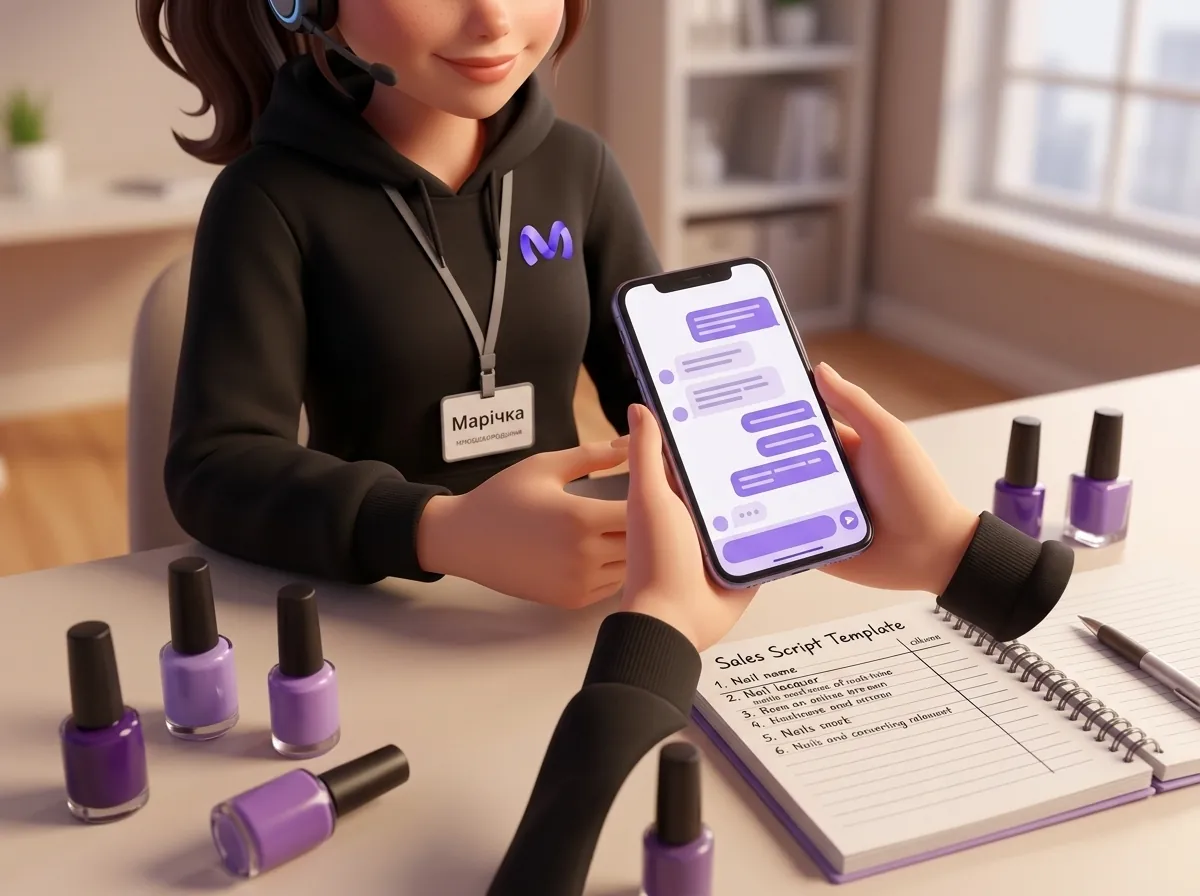
Review of the script based on records and correspondence once a month
A script that isn’t reviewed turns into a file that nobody opens within a month. Once a month, Marta selects ten conversations from Diana and Andriy (half of which are telephone calls) and notes down five elements for each one: present or absent. After an hour, a pattern emerges. Andriy says hello and makes a good offer, but in seven out of ten conversations there is no follow-up. Diana sometimes skips the questions and immediately recommends her favourite product.
This kind of analysis shows exactly where customers are being lost, without resorting to vague assumptions such as “Andriy isn’t very good at selling”. If you want to quantify this across the whole shop, take a look at, At which stage of the sales funnel do customers drop out?, and compare it with the element of the script that is missing.
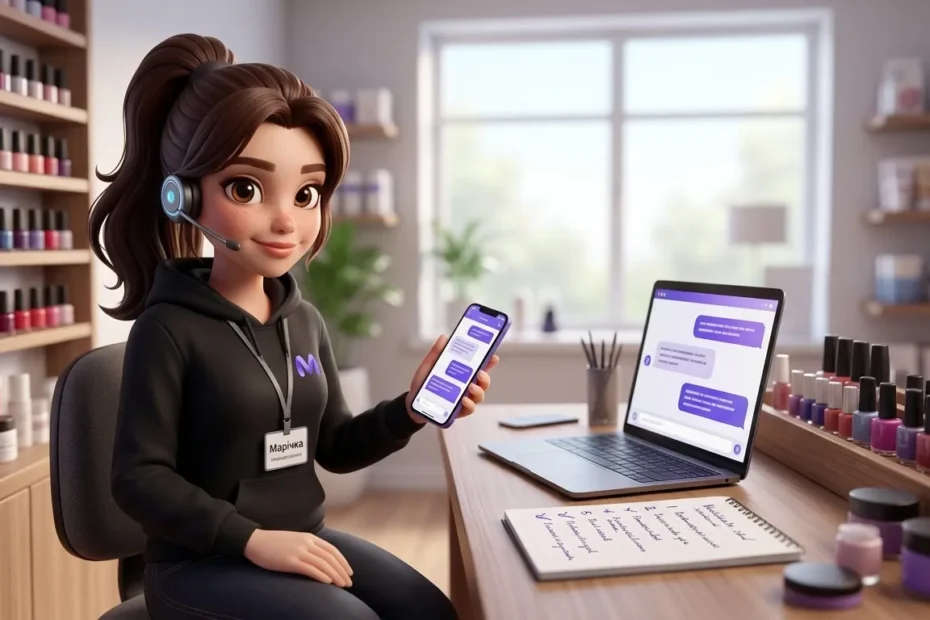
One particular bottleneck is the evening direct messaging. The craftswomen reply after their last customer has left, when the managers are already at home, and queries regarding stock and delivery remain unanswered until the morning. This part of the workflow, where information from the catalogue is required, can be handled by the Marichka AI sales manager: it responds in a matter of seconds, drawing solely on your knowledge base; it asks follow-up questions and forwards the conversation, complete with context, to a manager when a query goes beyond the scope of the catalogue.
Start small. Write down five points on a single sheet of paper, fill them in with the words of your best manager, and review ten conversations over the course of a week. Your first sales script won’t be perfect, but after the first review, you’ll know which lines to rewrite.

Ready to connect Marichka to your channel?
Marichka AI will help you automate communication, reply to clients 24/7 and increase sales.
Frequently asked questions
Is it possible to use a ready-made sales script found online?
You can use it as a template. Ready-made sales scripts are written for other people’s products and are often designed for cold calls, so if you use them as they are, they’ll sound like someone else’s words. Keep the five-part framework, but replace the questions, offer options and objections with those your sales managers hear every week.
Do you need a script for chatting on Direct?
It’s essential, and it’s shorter than a phone call. The elements are the same: a greeting tailored to the enquiry, a few questions, a proposal, addressing any concerns, and the next step. In written correspondence, it’s best to ask one question at a time and end each message with a call to action that the customer can take straight away.
How often should you update your sales script?
Review it once a month, checking call records and correspondence. It is worth updating it when a new objection arises, the product range or delivery terms change, or when one of the elements is consistently omitted from conversations.
Are a sales script and handling objections one and the same thing?
No. Dealing with objections is just one of the five elements of the script. The script outlines the entire conversation, from the greeting to the agreement, and the sections on handling objections take up just a few lines.
How can you get a new manager to follow a script?
Let him listen to a few conversations with an experienced colleague, then spend a couple of days replying via direct message with a cheat sheet in front of him. Don’t go through the whole conversation at once; break it down one element at a time: first the question, then the next step. There’s no need to learn the text word for word.