A sales chatbot brings in orders when it conducts seven conversations from start to finish. It greets the customer and selects a product, answers questions about price and availability, explains delivery and payment terms, handles objections, processes the order, hands the conversation over to a human at the right time, and follows up with those who go quiet. A button menu like “Catalogue / Contacts / Special Offers” covers at best the first point. Below, each scenario is broken down using the example of a small shop, showing what the bot should say and where it needs to stop.
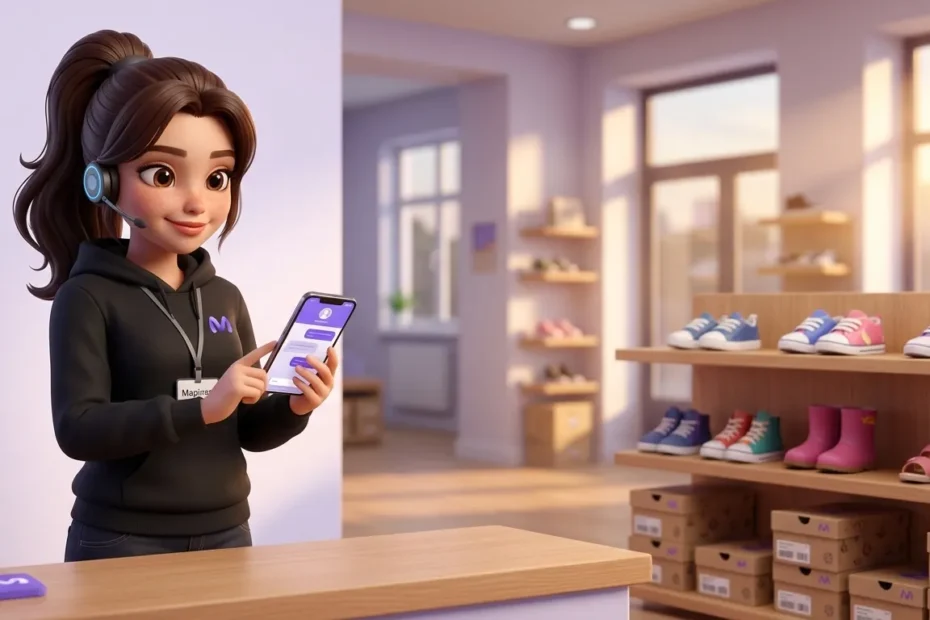
Imagine a children's shoe shop that sells via Instagram and a website, and manages orders in a CRM. On Monday at 23:15, a mum writes in Direct: “Good evening, are these boots available in size 27? The child is 4 years old, the foot is wide.” The managers are asleep until nine. We will go through this conversation scenario by scenario.
Contents
- Seven scenarios without which a sales chatbot does not sell
- The first message introduces the bot and asks one question
- Questions an experienced shoe sales assistant asks when helping customers choose shoes
- Price, availability and delivery without any fiction
- “Expensive”, “I'll think about it”, “What's your exchange policy like”
- The chatbot closes deals by creating orders in the CRM before the end of the conversation
- When a person hijacks the conversation
- Six messages to test the bot before launch
- Frequently asked questions
Section: AI for business
Seven scenarios without which a sales chatbot does not sell
The first three scenarios are informational. The bot greets the user and finds out what they need, selects a product based on the buyer's criteria, states the price and availability, and then the delivery and payment terms. Another four sell: responding to objections like “expensive” or “I'll think about it”, placing the order in the CRM, transferring the conversation to a human, and following up with those who have gone quiet.
Sales scenarios in a chatbot are often reduced to the top three. Then the bot replies like a directory, and the buyer still waits until morning for someone to take the order. The mum from our example finds out that size 27 is available and goes to sleep. Whether she remembers the boots in the morning when she opens her feed of ads from other shops no longer depends on you.
Each of the seven scenarios has its own logic, its own data from the knowledge base, and its own point where the bot stops. Below they are in the order in which they occur in the conversation.
The first message introduces the bot and asks one question
The bot should immediately state that it is the virtual assistant for the store and answer what was asked. A menu with five buttons in response to a specific question about size 27 looks like being ignored.
Honest representation for some buyers is already mandatory. Article 50 of the AI Act, which applies from 2 August 2026, requires that a person knows they are communicating with an AI system. This must be communicated clearly and no later than the first interaction. If you sell to Poland or Romania, this requirement applies to you directly. For Ukrainian buyers, it is useful as a standard: the phrase “I'm Marichka, the store's virtual assistant, I'll help you with the size” doesn't put anyone off.
One more clarification. In our conversation, the mother has already stated the foot size and width, so the bot is asking for what is missing: “Are you looking for the autumn season or already for winter?” A four-question survey in a row in Direct at 23:15 ends with the person closing the chat.
Questions an experienced shoe sales assistant asks when helping customers choose shoes
A good salesperson doesn't ask “what are you looking for”. They know which two or three parameters eliminate the majority of the catalogue, and ask about those specifically. For children's shoes, these are foot length in centimetres and width. The season comes third. For cosmetics, it will be skin type and sensitivity, and for furniture, room dimensions.
These parameters need to be added to the knowledge base along with the rules. For example: “add 1–1.5 cm to the foot length for growth” or “models for wide feet: such and such”. The bot does not make up the size chart, it takes it from your tables. Therefore, it is important that they are in the base in the form in which the female manager reads them.
Once the parameters have been gathered, the bot displays the options. In Instagram, a card carousel is used for this: according to Meta's documentation, a message template can hold up to 10 cards, each with up to three buttons, and the card title is limited to 80 characters. In practice, three or four cards are enough. Mum won't compare ten similar pairs of shoes on her phone; she'll just ask, “so what do you recommend?”

Price, availability and delivery without any fiction
This is where the bot most often loses trust. A buyer asks “do you have size 27?”, the bot says “yes”, and in the morning a female manager writes that the last pair was sold on Saturday. A cancelled order kills the desire to buy much more than an honest “we don't have it”.
The rule is simple: the bot replies only from the knowledge base, and the base is updated automatically. In Marichka AI, for example, the catalogue is pulled in by website scraping or by importing from PDF and Excel, while prices and availability are updated daily. If your stock levels change every hour (a sale, one pair per size), discuss this at the start and agree that the bot should say for such items “I'll check availability and message you in the morning”.
The bot states delivery and payment in full, including the terms: carrier, delivery time, who pays for returns, and whether cash on delivery is available. For a mother buying for the first time, it is important to hear about trying items on and returns before she even asks. Then the question “what if it doesn't fit” will not become an objection.
If questions like this pile up by the dozen in your direct messages overnight, start checking the bot with these three scenarios. A customer notices a pricing or availability error first, and that is precisely what costs you the order.
“Expensive”, “I'll think about it”, “What's your exchange policy like”
Objections in messaging sound brief, and the bot needs to respond to them directly, without pressure. To “expensive”, it is appropriate to explain what the price is for (leather, arch support, manufacturer) and show a cheaper model with the same parameters, if one is available. To “what if it doesn't fit”, repeat the exchange terms. The bot does not invent a discount: if there is no promo code in the database, there isn't one.
“I'll think about it” is usually the most acceptable response. The bot can suggest putting a pair on hold until tomorrow or sending a reminder if the customer agrees. This is a sales funnel chatbot and it works like a funnel: a person who hasn't bought today stays in the CRM with their contact details and the model they were looking at.
The reminder is indeed the seventh scenario, the quietest of them all. Mum replied, “I'll think about it, I'll consult my husband,” and went to bed. The next evening, the sales chatbot writes a single message: “Good evening! The size 27 boots are still held until 20:00. If it suits you, I'll process the order now.” Without “still thinking?” and without three reminders in a row. If there is no reply, the contact remains in the CRM, and the manager decides for herself whether to write again.
The tone and timing of such messages are configured in the settings just like the size chart. The bot has no right to remind someone who has explicitly refused. How to write reminders without being annoying is what we discussed in the article About follow-ups in messengers.
The chatbot closes deals by creating orders in the CRM before the end of the conversation
The chatbot closes deals when an order enters the CRM while the buyer is still in the chat. The response “I'll pass this to a manager, you'll get a call” at 23:20 defers the purchase until morning, and by morning the person might find the same model elsewhere.
To process the order, the bot collects a minimum of fields: name and phone number, city and delivery branch, model and size, and payment method. Then it repeats the order in a single message: “Size 27, model such-and-such, 1 pair, delivery to branch 12 in Vinnytsia, cash on delivery. Is everything correct?” After “yes”, the order is created in the CRM with the status the manager starts working from in the morning. The buyer receives confirmation immediately.
A separate issue is prepayment. If you work exclusively with cash on delivery, the bot simply records the payment method. If you take prepayment, decide in advance who sends the bank details or payment link: the bot immediately or a manager after checking the order. The second option is slower, but it protects against a situation where a person has paid for a pair that is no longer in stock.
The steps of this dialogue using a direct message example are shown in more detail in the breakdown of, how an AI agent guides a customer from the first message to an order.
When a person hijacks the conversation
The sales department bot acts as the first line, and it should hand over some conversations immediately. Even the best-configured sales chatbot should not negotiate wholesale prices or deal with defective goods. Here are the situations that should be defined as handover rules:
- complaint, defect, disputed return;
- wholesale order or request for bespoke terms;
- a question to which there is no answer in the knowledge base;
- the buyer is asking directly for a real person;
- second repetition of the same question (the bot clearly didn't understand).
It is important how the handover actually takes place. The manager needs to see the entire conversation and collected data so she doesn't have to ask about the size and city again. The bot honestly tells the buyer when a human will reply: “I've passed your question on to the manager, she is available from 09:00.” A blank “please wait” at half past eleven at night is worse than a precise time.
Six messages to test the bot before launch
Before turning the bot on for real customers, message it yourself from your personal account. Six messages cover all the scenarios above:
- “Do you have these boots in a size 27?” without providing a link to the model. The bot needs to clarify which model is meant. A confident “yes, we do” without clarification here means the test is a failure.
- “Child is 4 years old, foot is 16.5 cm, wide, for autumn. Check if the suggestions match your size chart.
- “How much is it with delivery to Vinnytsia and can I pay on receipt?”
- “Expensive. Is there a discount?” The bot shouldn't promise a discount that you don't have.
- “I’ll take it, 27, Vinnytsia, branch 12, Olena, 067…” Check that the order is in the CRM with all fields.
- “A pair has arrived with a defect.” The conversation needs to be transferred to the person with the full context.
Fix every error in the knowledge base. If you only correct the bot in the chat, the rule won't be recorded anywhere, and with the next customer it will make the mistake again. When all six messages pass cleanly, the sales chatbot is ready for the night shift. It's handy to run this test on your own catalogue during a 7-day free trial and see how many night conversations end up as an order in the CRM.
Ready to connect Marichka to your channel?
Marichka AI will help you automate communication, reply to clients 24/7 and increase sales.
Frequently asked questions
Can a chatbot close deals on its own?
Perhaps, if the product is standard and the price and availability are in the knowledge base: the bot collects the customer's data, confirms the order contents, and creates it in the CRM. Individual discounts, wholesale terms, and disputed returns are best left to a human. You set the boundary in the settings, not the bot.
How many sales scripts should be set up at the start?
Start with those that close most incoming questions in your direct messages. In a shop, these are usually availability, price including delivery, size selection, and placing an order. To find them, review the last 50 conversations and write down the repeating questions. Add objections and reminders when the first scenarios are working without errors.
Should the client be told that a bot is responding to them?
Right. For EU buyers this is a legal requirement: Article 50 of the AI Act requires notifying a person that they are interacting with an AI no later than the first interaction, starting from 2 August 2026. For a Ukrainian buyer, it is a matter of trust: a person who figures out on their own that they were talking to a bot is less likely to return.