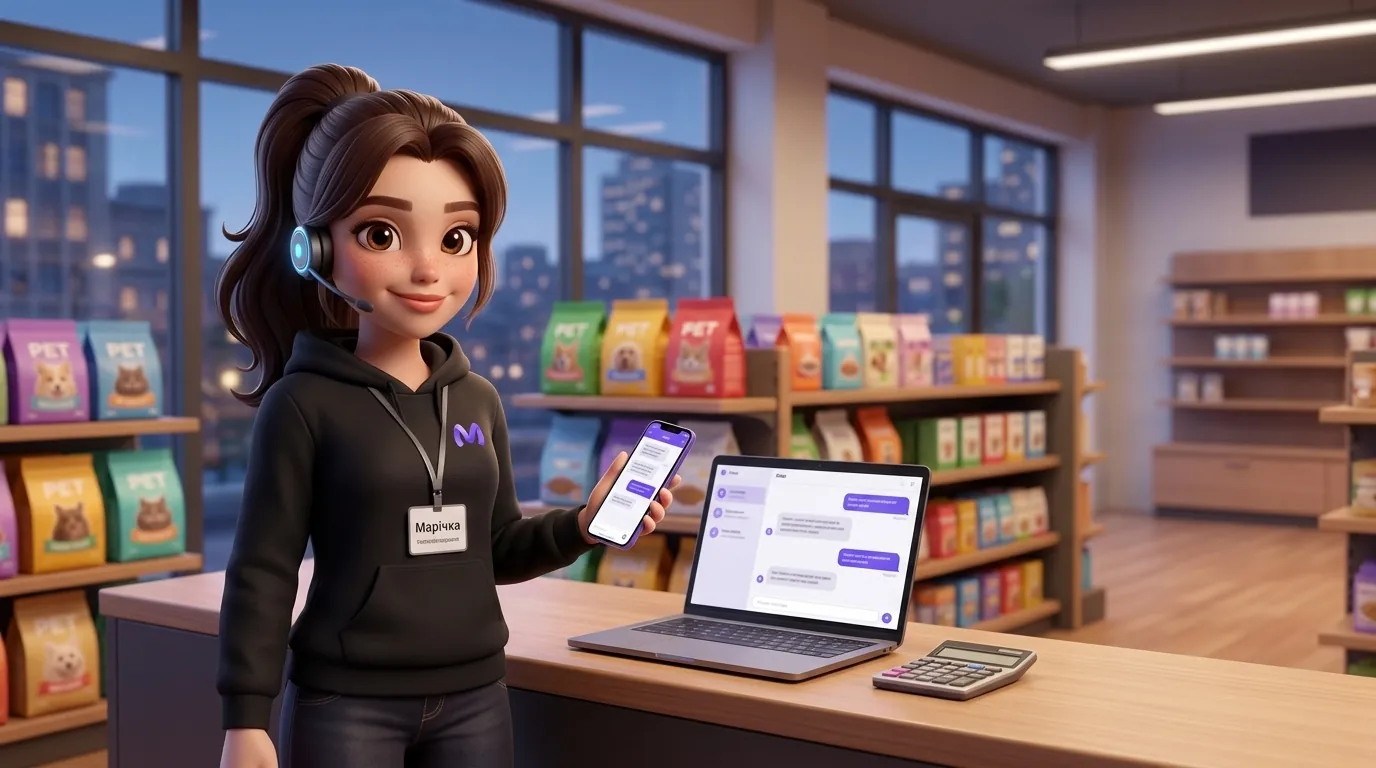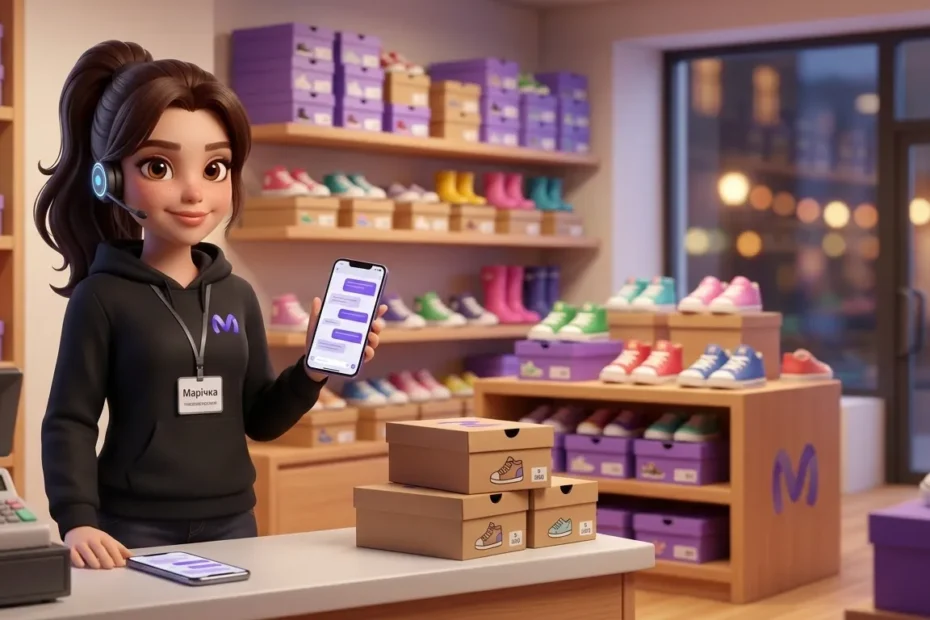
In most shops, retail automation stops at the till, stock-taking and the warehouse. The next area where everything is still done manually is communicating with customers on Instagram and Viber. This is exactly where you should start with a chatbot: with repetitive queries about stock, prices, opening hours and exchanges, which currently take up sales staff’s time between serving customers.
Contents
- Retail automation usually stops at the till
- The shop’s process map shows where there is still manual labour involved
- What to prepare before setting up a chatbot for the retail sector
- The first five questions you should ask the bot
- The bot explains the exchange and returns policy, but does not resolve the issue
- How AI for the retail sector turns a conversation into an order
- The first month of retail digitalisation: the budget and what to take into account
- Frequently asked questions
Section: AI for business
Retail automation usually stops at the till
When a shop owner hears the word “automation”, they think of a software-based cash register, an accounting programme, a barcode scanner and scales. This is a logical sequence: you cannot sell without a till, and you cannot see your stock levels without accounting. Almost all articles on this topic focus specifically on these three things.
Let’s take Irina as an example. She has two shops selling children’s clothes and shoes in Vinnytsia, an Instagram page and a Viber chat for regular customers. The till prints tax-compliant receipts, the CRM system tracks stock levels, and orders are sent to suppliers based on the stock report. And in her direct messages, she receives several dozen messages a day: “Do you have these trainers in size 28 at the Keletska branch?”, “What time do you close today?”, “Please put these aside until Saturday”. A sales assistant replies when the shop is quiet, or Irina does so in the evening.
The number of shoppers who ask questions first and then visit the shop is not decreasing. According to eSputnik, in a sample of 946 online trading and retail companies, website traffic in May 2026 reached 188.7 million visits, whilst the conversion rate fell to 1.31 per cent, compared with around 1.9 per cent in January (Ekonomichna Pravda, 29 October 2026). Among the reasons cited by the authors is a higher proportion of new customers, who take longer to make a decision. People spend more time comparing options and write more often before making a purchase.
For a shop that operates exclusively online, the logic is similar, but without physical outlets or a collect-your-order service. More on this scenario separately: how a bot guides a customer through the ordering process in an online shop.
The shop’s process map shows where there is still manual labour involved
Before you buy anything, break down the shop’s daily routine into tasks and take an honest look at who is currently responsible for them. This is the table Irina came up with.
| The process | What is currently closed? | Who wastes time? | What can the bot do? |
|---|---|---|---|
| Sale and receipt | Software-based cash register | Cashier | Nothing |
| Stock levels and purchases | CRM, reports | Irina once a week | Nothing |
| Enquiries regarding availability and price | Not at all | A shop assistant amongst the customers | Answer from the catalogue |
| Timetable, addresses, delivery | Profile header | Iryna, the shop assistant, in the evening | Answer from the knowledge base |
| “Leave it until Saturday” | A note by the till | Shop assistant | Orders for collection in the CRM |
| Exchanges, defects, complaints | Not at all | Irina | Explain the rules and pass them on to the person |
The first two lines are already automated, and there’s no point in adding another programme there. Everything below that is correspondence. That’s where the next step in the digitalisation of retail lies for a shop of this size.
What to prepare before setting up a chatbot for the retail sector
The bot only responds based on what you’ve given it. That’s why most of the set-up process boils down to three things, and the actual configuration takes less time. This is precisely where retail automation most often gets bogged down: the data is there, but it’s scattered across notebooks and chat rooms.
Catalogue and stock levels by outlet
The product range can be downloaded from the website, as a PDF or Excel file, and prices and stock levels will be updated automatically. Check one detail that is more important in a high-street shop than in an online shop: whether stock levels are broken down by shop. If the file simply states “size 28 – 3 pairs”, the bot won’t know whether they’re at the Keletska branch or another outlet. A separate column with the address resolves this issue.
Shop rules in writing
Opening hours for each outlet, addresses with landmarks, how long you hold items on hold, which payment methods you accept, and exchange conditions. Iryna found out that sales assistants held reserved items “until the evening”, “until tomorrow” and “for as long as necessary”, depending on the shift. The bot needs just one answer, and this is decided by the owner.
Who takes over the conversation when the bot doesn’t know?
Assign a person and a time when they will respond to the forwarded conversations. If a query arrives at 10.00 pm, the customer should receive an honest reply from the bot saying, “I’ve passed this on to the manager; she’ll reply in the morning”, whilst the manager should receive the full chat history so she doesn’t have to ask the same questions again.
The first five questions you should ask the bot
Don’t try to cover everything at once. In retail outlets, the following questions come up most frequently:
- Is the item available in the right size or colour, and in which shop?
- How much does it cost? Is there a discount on this model?
- What are the shop’s opening hours, and how can I find it?
- Is it possible to put goods on hold, and until what date?
- Can I exchange it if the size isn’t right?
To check whether these are indeed the top-performing products in your shop, all you need is a single day’s monitoring of Direct. We’ve covered how to filter processes by these criteria in a separate guide: how to select processes for the bot based on a single day’s observations. For Irina, the question about the size at a specific point came first, and the weekend schedule came second.
The bot explains the exchange and returns policy, but does not resolve the issue
The fifth question on the list is the most sensitive. The answer is laid down in law, and a mistake here could lead to a dispute with the buyer.
Article 9 of the Law of Ukraine “On the Protection of Consumer Rights” entitles consumers to exchange non-food goods of satisfactory quality within 14 days, excluding the day of purchase, unless the seller has specified a longer period. The goods must not have been used and must retain their marketable appearance. Labels must remain in place, and the buyer must have a receipt or an electronic payment document. Separately, the State Service for Food Safety and Consumer Protection reminds consumers that this also applies to promotional goods, provided the discount is not linked to a defect (Clarification dated 9 October 2025). Certain goods are not eligible for exchange; the list of these goods is set out in Cabinet of Ministers Resolution No. 172.
Add these rules to the knowledge base in your own words, along with any specific conditions you may have, such as a longer exchange period, if you offer one. Then, when asked, “Can I exchange these promotional trainers?”, the bot will respond in accordance with the law and your rules, day or night. The decision regarding a specific pair that has already been worn remains with the sales assistant: the bot simply relays the conversation and makes no promises beyond the rules.
How AI for the retail sector turns a conversation into an order
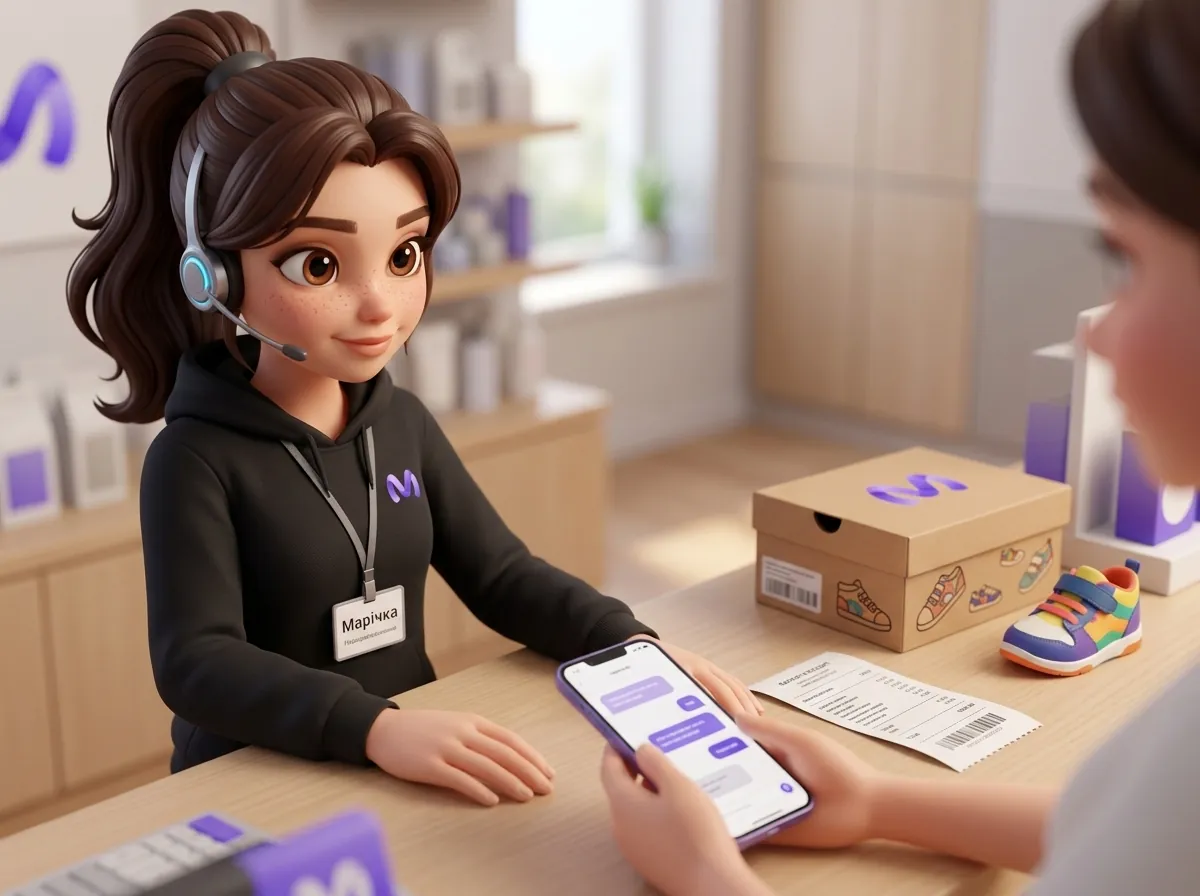
Marichka AI, the AI sales manager, replies via Instagram Direct, Viber, Telegram, Facebook, WhatsApp and the website widget within 10–30 seconds, at any time of day. It reads your catalogue and guidelines, so it can answer questions about size 28 straight from the file. If a model isn’t in the catalogue, it will tell you so.
The conversation doesn’t end there with a simple “yes, we have it”. The customer writes “put it aside until Saturday”, the bot confirms her name, telephone number and collection point, and creates a self-collection order in the CRM. The sales assistant sees it in the same way as an order from the website and sets a couple aside at the till. In the morning, Iryna can see how many such bookings came in overnight.
When a query goes beyond the scope of the knowledge base, the bot hands the conversation over to a human, along with the entire chat history. This happens with stock shortages, personalised discounts or bulk orders for a nursery. This is where the difference from an automated reply becomes clear: a template responds identically to everything, whereas AI for retail can distinguish between what it has an answer for and what it doesn’t.
If there are dozens of unanswered questions in your Direct messages in the evenings that remain unanswered until the morning, you can check this with your own customers, without changing your till system or CRM.
The first month of retail digitalisation: the budget and what to take into account
According to the pricing table on the Marichka AI website (November 2026), the LITE plan costs €49 per month and includes 1,000 messages and two managers who handle the forwarded conversations. There is a 7-day free trial before payment is required. No-code setup: catalogue, rules, channel.
There are three things worth keeping track of. How many conversations did the bot close on its own, without passing them on to a human? How many bookings and orders have been generated in the CRM from the chat, particularly after the shop has closed. And how much time the sales assistant now spends on the phone rather than on the shop floor. The first two figures can be seen in the CRM; it’s easier to ask her directly about the third at the end of the week.
Automating retail operations beyond the till doesn’t require new accounting software. It starts with the questions your customers ask every day – questions you already have the answers to, but which are simply stored in the sales assistant’s head. So the first step is simple: spend a week noting down what people ask via Direct and Viber, and list the stock levels in the catalogue by branch. With this list, setting up the bot simply involves transferring the ready-made answers into the knowledge base.

Ready to connect Marichka to your channel?
Marichka AI will help you automate communication, reply to clients 24/7 and increase sales.
Frequently asked questions
What does retail automation involve?
There are usually three layers. The first is the till and the software-based cash register. The second is the management of stock, stock levels and purchases. The third involves customer service: replying to messages on instant messaging apps, taking orders via chat, and sending reminders. Most shops have already sorted out the first two layers, whilst the third still relies on shop assistants.
Does a shop with just one branch need a chatbot?
This is needed if people message you daily via Direct and Viber, and the same person who works at the till replies to them. In that case, enquiries about sizes or prices are dealt with when there are no customers in the shop. If there are only a few messages a week, you can put the bot on hold.
Does the bot know what’s in stock at a particular shop?
It only knows what you’ve given it. If the stock levels are listed by outlet in the product range file or on the website, the bot responds based on those figures, whilst the auto-refresh function displays the current figures. If the stock levels are only in the sales assistant’s head, the bot should honestly say that it will check and pass the enquiry on to a member of staff.
Will a bot replace the sales assistant on the shop floor?
No. The bot handles the chat: repetitive questions, product reservations and placing orders via chat. Fittings, in-person advice, exchanges and disputes are still the seller’s responsibility. The seller simply no longer has to spend time answering the same question twenty times a day.